

Setting up a home gym under 500 dollars is entirely possible, but you won’t find a single “official” shopping list that works for everyone. Most guides either skip the hard budget math or push pre-made bundles that actually cost more. This guide provides a realistic, actionable plan that acknowledges what the research doesn’t tell you, gives you a dollar-by-dollar breakdown, and shows you exactly where to spend, save, and compromise to build a functional beginner setup that fits in your apartment and lasts beyond the first month.
Key Takeaways
- No expert-recommended budget splits exist for $500 home gyms, so this guide synthesizes a practical allocation using 2024 price data across strength, cardio, and accessories.
- Curated individual buys often beat pre-made bundles under $500 because bundles typically start at $1,000 and omit flooring, quality dumbbells, or clear warranty terms.
- Your biggest risks are hidden costs (shipping, assembly), missing warranty details, and compromising on weight capacity or material quality for core strength gear.
- Why there’s no single “official” $500 breakdown and what that means for this guide
- Editorial recommended budget allocation (the percentage split and why)
- A $500 sample shopping build (line-item recommended items + target price)
- Durability, quality, and common buyer complaints to watch for
- The warranty & capacity buying checklist (non-negotiables for core strength gear)
- What bundle-deals miss (and why curated buys can be cheaper)
- Real cost tradeoff: package deal vs curated buy (how to calculate expected savings)
- Floor-space realities & common user compromises
- Two to three best-value add-ons pro reviews like to recommend (but bundles often omit)
- Final buying & setup checklist (shipping, assembly, flooring, storage, and next steps)
- Frequently Asked Questions
Why There’s No Single “Official” $500 Breakdown and What That Means for This Guide
If you’ve been searching for an authoritative, expert-backed percentage split for a home gym under 500 dollars, you’ve already discovered the problem: it doesn’t exist. No specific expert-recommended percentage breakdowns for a $500 beginner home gym budget appear in the search results, such as 40% cardio, 50% strength, and 10% accessories. That gap matters because it means most guides either guess, push affiliate bundles, or ignore the hard tradeoffs a real $500 ceiling forces.
This guide takes a different approach. We synthesize a pragmatic allocation based on documented 2024 average price ranges: cardio equipment like rowers runs $300 to $2,000 and bikes $200 to $2,200; strength gear such as power racks costs $300 to $1,800 and dumbbells $100 to $500; accessories including mats range $20 to $100 and bands $10 to $60. These numbers make it clear that a balanced budget home gym setup under $500 will require hard choices, especially on cardio, and you’ll need to know exactly where to compromise and where not to cut corners.
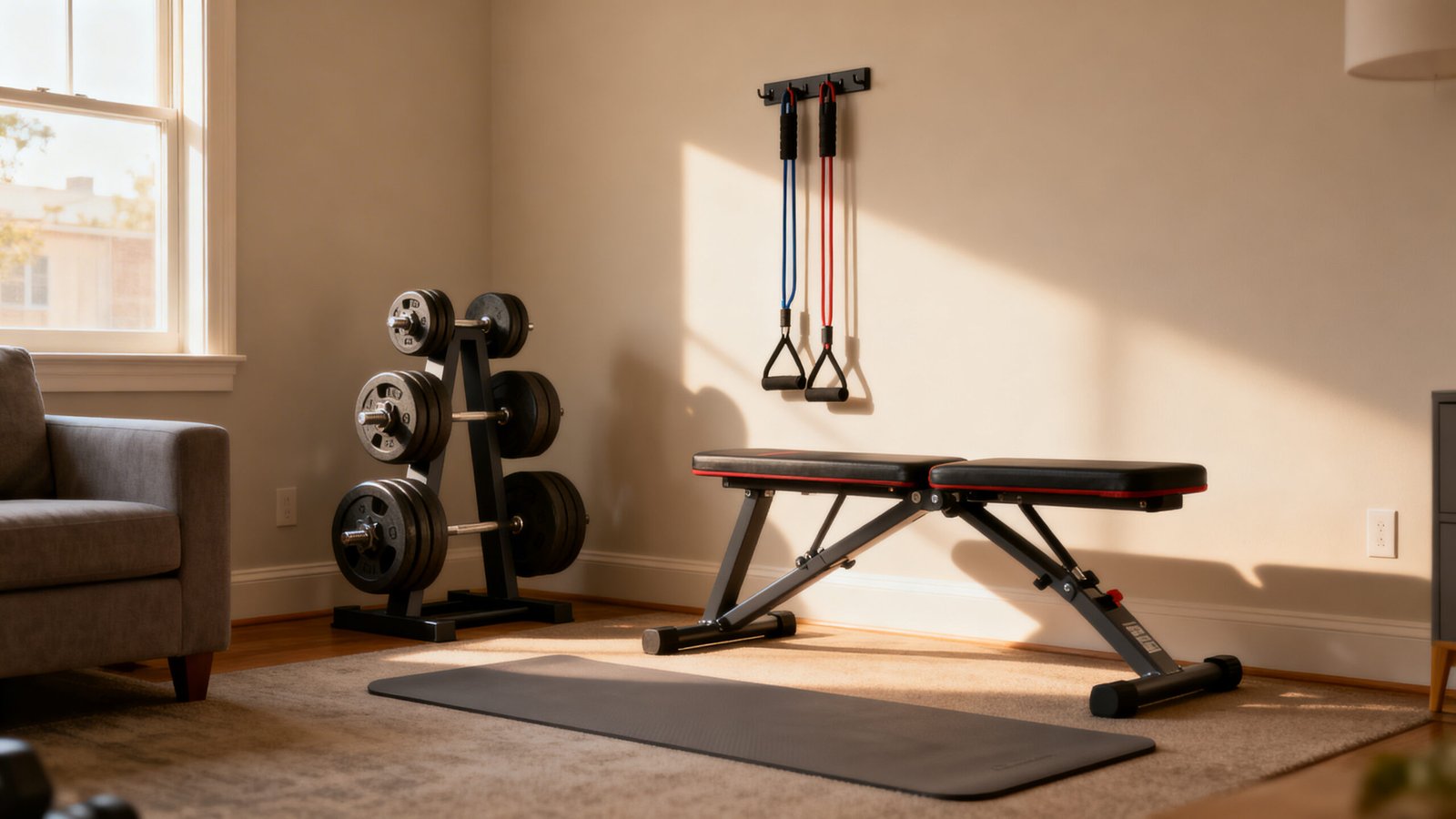
Editorial Recommended Budget Allocation (The Percentage Split and Why)
Since authoritative breakdowns are absent, here’s our editorial recommendation for a complete home gym under 500 dollars that prioritizes strength training, includes minimal cardio, and covers essential accessories:
- Strength (60% / $300): Adjustable dumbbells or a single pair of fixed weights plus a flat bench. This is your foundation for progressive overload and full-body work.
- Cardio (20% / $100): A jump rope, resistance bands for cardio circuits, or savings toward a used bike. Full cardio machines eat budgets fast, so this allocation keeps you moving without blowing the total.
- Accessories & Flooring (20% / $100): A quality exercise mat, resistance band set, and basic flooring protection. These prevent injury, protect your floor, and extend equipment life.
This split reflects the reality that basic setups under $500 to $1,000 typically prioritize adjustable dumbbells, flat or adjustable benches, resistance bands, and yoga mats, with cardio often limited due to cost. If you’re cardio-first (training for a 5K, for example), flip the percentages: allocate 50% to a used stationary bike or rower and 30% to bodyweight and band-based strength work. If you’re space-limited in a studio apartment, drop the bench and go all-in on adjustable dumbbells and bands, saving $120 to $150 for future upgrades.
A $500 Sample Shopping Build (Line-Item Recommended Items + Target Price)
Here’s a concrete, buy-now shopping list for the best home gym for beginners on a budget, using the 60/20/20 allocation above. Total target: approximately $500.
| Item | Target Price | Notes |
|---|---|---|
| Adjustable dumbbells (up to 50 lbs per hand) | $180–$220 | Look for plate-loaded or dial systems; avoid anything under 200 lb total capacity |
| Flat utility bench | $80–$120 | Minimum 600 lb capacity; check for stable, wide legs and thick padding |
| Resistance band set (3–5 bands) | $20–$40 | Used for cardio circuits, warmups, and assistance work |
| Jump rope (speed or weighted) | $15–$25 | Adjustable length; ball-bearing swivel preferred |
| Exercise mat (6 ft × 4 ft minimum) | $30–$50 | At least ½ inch thick; protects floor and provides cushion for floor work |
| Interlocking foam floor tiles (optional) | $30–$50 | Covers 24–48 sq ft; protects apartment floors from dumbbell drops |
| Estimated Total | $355–$505 |
This list reflects the 2024 price point ranges for each category and leaves a small cushion for shipping or tax. If you’re over budget, drop the foam tiles initially and use the existing mat, or buy a single pair of fixed dumbbells (25 to 35 lbs) for $60 to $80 instead of adjustable sets. If you find a quality used bench locally for $50, reallocate that $30 to $70 savings toward heavier dumbbells or a doorway pull-up bar.
Durability, Quality, and Common Buyer Complaints to Watch For
Budget equipment under $500 carries real risks. General warnings note that less expensive equipment often uses lower quality materials and lacks durability, but specific complaint data for sub-$500 bundles is absent from major retailer reviews. That means you must be your own quality control inspector.
Red Flag Checklist (Apply to Every Product Page and Review)
- Materials: Avoid benches with hollow steel tubing under 2 inches in diameter, dumbbells with plastic-threaded collars, and mats thinner than ¼ inch. Look for powder-coated or chrome-plated finishes instead of bare paint.
- Welds and Fasteners: Read reviews for mentions of “wobbly,” “loose bolts out of the box,” or “cracked welds.” Check product images for visible weld quality and thick bolt heads.
- Assembly and Instructions: Products with 1-star reviews citing “missing hardware” or “instructions in broken English” will waste hours and may be unsafe. Prioritize brands with video assembly guides on YouTube.
- Weight Capacity Ambiguity: If a product page lists “supports up to 300 lbs” without clarifying static vs. dynamic load, assume the lower number and email the seller before buying.
- Return Policy Gaps: Budget brands often charge restocking fees (15% to 25%) or require you to pay return shipping on 50+ lb items. Verify the return window and who pays freight before checkout.
For a budget home gym setup, the single most common failure point is the bench. Thin padding compresses into hard board within weeks, and undersized legs can’t handle dynamic movements like step-ups or single-leg work. Spend the extra $20 to $40 for a 600 lb+ rated bench with at least 2-inch thick padding and reinforced leg joints.
The Warranty & Capacity Buying Checklist (Non-Negotiables for Core Strength Gear)
Research shows that search results lack specific warranty terms (years, coverage) or weight capacity limits for budget adjustable dumbbells or power cages/racks. That absence puts the burden on you to demand clear answers before purchase. Here’s what to require for any home gym under 500 core strength item:
Adjustable Dumbbells
- Minimum Warranty: 1 year on frame and plates, 90 days on locking mechanisms or dials.
- Minimum Capacity: 200 lbs total (pair of 50 lb dumbbells minimum) with clear documentation of max weight per handle.
- Verification Step: Email or chat the seller: “What is the warranty period for the frame, plates, and locking mechanism? What is the maximum safe weight per dumbbell handle, and is that documented in the manual?”
Flat or Adjustable Bench
- Minimum Warranty: 1 year on frame, 90 days on padding and stitching.
- Minimum Capacity: 600 lbs for flat benches (to safely handle user + dumbbells during presses); 500 lbs for adjustable benches.
- Verification Step: Check the Q&A section on the product page or contact support: “Is the stated weight capacity static or dynamic? Does it include the user’s body weight?”
If a seller cannot or will not answer these questions in writing, walk away. The savings aren’t worth a collapsed bench or a handle that shears off mid-set. For a complete home gym under 500 dollars, your dumbbells and bench represent 60% of your budget and carry the highest injury risk, so this is where you enforce non-negotiables.
What Bundle Deals Miss (and Why Curated Buys Can Be Cheaper)
Pre-made home gym equipment package deals under $500 are nearly nonexistent in 2024 research. No specific 2024 pre-made package deals under $500 or direct cost comparisons including shipping are provided; bundle deals start at $1,000 for basic sets. That means if you see a “complete home gym” advertised under $500, it’s either used, clearance, or missing critical components.
Typical Omissions in Budget Bundles
- Flooring or Mats: Bundles assume you’ll use carpet or bare floor, which damages both the floor and your equipment.
- Quality Adjustable Dumbbells: Bundles often include fixed-weight dumbbells in 5 lb increments (10, 15, 20 lbs), forcing you to buy more pairs as you progress.
- Explicit Warranty and Capacity Details: Package descriptions list “1-year warranty” without specifying coverage (frame only? parts and labor? user error exclusions?).
- Realistic Shipping Costs: A $499 bundle often adds $75 to $150 in freight shipping, putting the true cost at $575 to $650.
Bundle Evaluation Playbook
- Itemize every piece in the bundle with its standalone retail price (use the 2024 price ranges above).
- Add the advertised shipping cost plus any assembly fees.
- Compare the total to your curated build from the sample shopping list.
- Verify warranty terms and weight capacities in writing before purchase.
- If the bundle saves less than $50 after shipping or omits flooring and quality dumbbells, curate individual pieces instead.
For most apartment and small-home buyers, curating cheap home gym equipment set components beats bundles because you control quality, avoid paying for items you don’t need (like a weight tree or Olympic barbell you can’t use in 500 sq ft), and can buy used locally to dodge shipping.
Real Cost Tradeoff: Package Deal vs Curated Buy (How to Calculate Expected Savings)
Let’s walk through a concrete comparison to show you how to calculate whether a package deal or curated buy delivers better value for your complete home gym under 500 dollars.
Hypothetical Bundle Example
Advertised Price: $499
Included Items: 3 pairs fixed dumbbells (15, 20, 25 lbs), flat bench, resistance band set, yoga mat, jump rope
Shipping: $89 (freight to residential address)
Assembly: Required, no service offered
Warranty: “1 year limited” (frame only, per FAQ)
True Total: $588
Curated Build (Using Sample List Above)
Adjustable Dumbbells (Amazon, free Prime shipping): $199
Flat Bench (local Marketplace pickup): $60
Resistance Bands (retail): $30
Jump Rope: $20
Mat: $40
True Total: $349
Savings: $239
Tradeoff: The curated build requires hunting for a used bench and accepts free Prime shipping instead of freight, but delivers adjustable dumbbells (vs. three fixed pairs) and saves enough to add foam floor tiles ($40) and still pocket $200.
This calculation assumes you can find a quality used bench locally. If not, add $80 to $120 for a new bench, bringing your curated total to $429 to $469, still $119 to $159 under the bundle’s true cost. The key insight: curated basic setups total $500 to $1,000, potentially cheaper than bundles but without quantified savings or shipping details, so you must do the math yourself every time.
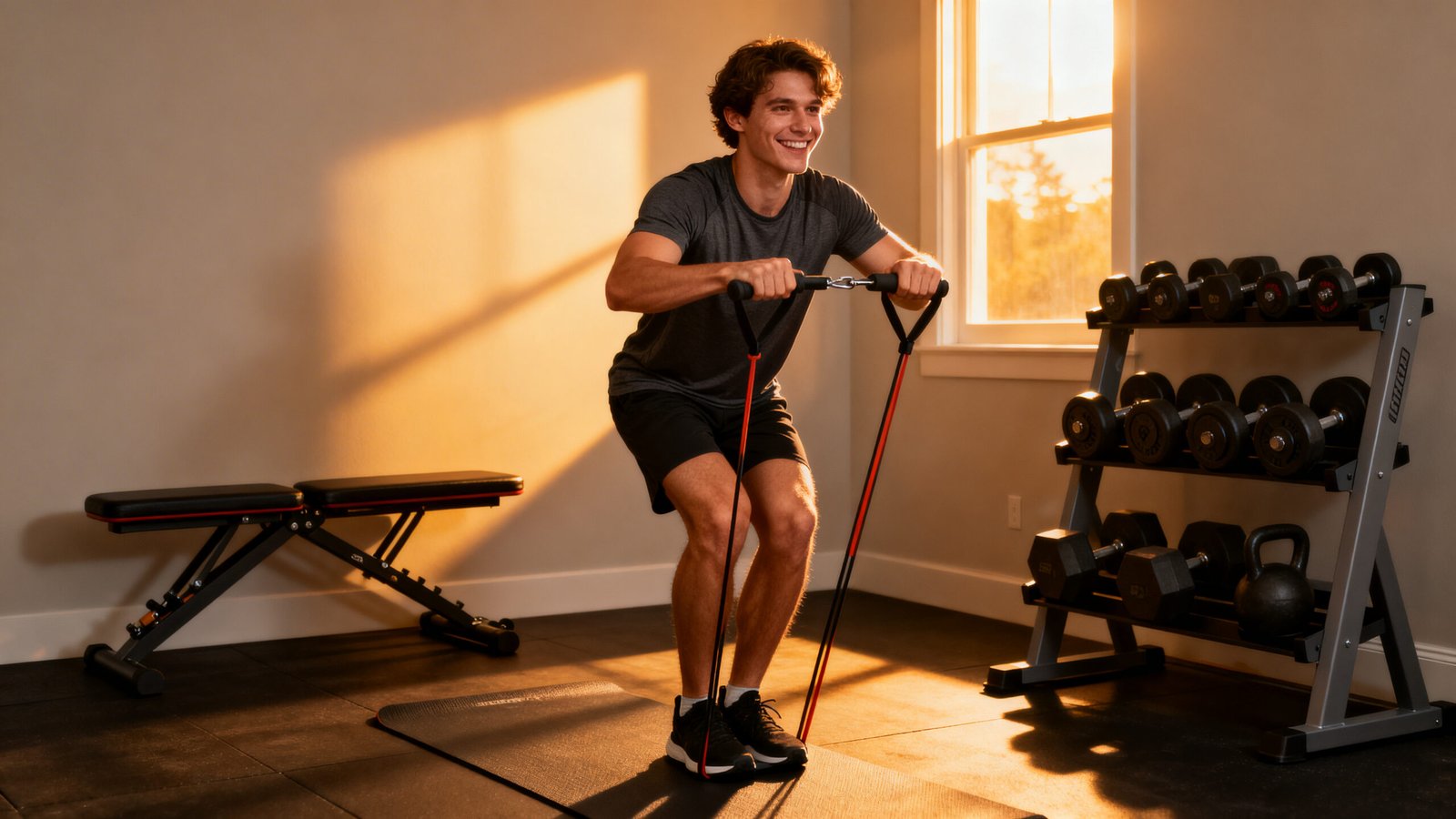
Floor Space Realities & Common User Compromises
No post-assembly floor space footprints in square feet are given for $500 setups with racks, benches, and cardio; basic setups suit small apartments but lack measurements. That means you’ll need to measure conservatively and plan for these typical space requirements:
Conservative Space Planning for a Basic Setup
- Flat Bench: 4 ft long × 1.5 ft wide, plus 2 ft clearance on each side for dumbbell movements = 8 ft × 5.5 ft working area (44 sq ft).
- Jump Rope Zone: 8 ft × 6 ft clear space (48 sq ft) with 8 ft ceiling clearance minimum.
- Storage for Dumbbells and Bands: 2 ft × 2 ft floor space or wall-mounted rack (4 sq ft).
- Total Minimum: 50 to 60 sq ft of dedicated floor space, or roughly a 7 ft × 8 ft corner of a room.
Most Common Space Compromises
- Folding or Flat-Pack Bench: Reduces storage footprint to under 1 sq ft when folded, but adds 30 seconds setup time per workout.
- Skipping Cardio Machines: Jump rope and resistance band circuits require no permanent footprint.
- Wall-Mounted Dumbbell Rack: Keeps weights off the floor and frees up 4 sq ft.
- Using a Multipurpose Room: Store bench under a bed or vertically in a closet; roll out a mat only during workouts.
For the best home gym for beginners on a budget in an apartment, your biggest friend is vertical storage and foldable gear. Prioritize equipment that packs flat or mounts on walls, and measure your workout zone with a tape measure and painter’s tape on the floor before buying anything over 4 ft long.
Two to Three Best Value Add-Ons Pro Reviews Like to Recommend (but Bundles Often Omit)
Professional reviews consistently highlight these three categories as high-value supplements, yet they’re typically missing from cheap home gym equipment set bundles:
1. Quality Resistance Band Set with Door Anchor
Why It Matters: Adds 50+ exercises (rows, face pulls, leg curls, hip abduction) for $20 to $40. Bands also double as cardio tools for circuits and provide variable resistance that’s easier on joints than dumbbells for warmups.
What to Buy: Look for latex or fabric bands rated to 50+ lbs resistance, includes a door anchor and handles, and comes with a carry pouch. Avoid single-loop bands without handles for a beginner setup.
Typical Bundle Gap: Bundles include one or two light bands (5 to 15 lbs) without anchors or handles, forcing you to buy a real set separately.
2. Foldable or Adjustable Bench (Not Just Flat)
Why It Matters: An adjustable bench (incline, decline, flat) unlocks 20+ additional exercises (incline press, decline situps, single-arm rows) and folds to under 6 inches thick for storage.
What to Buy: Minimum 500 lb capacity, at least 5 backrest positions, and a folding mechanism that locks securely. Expect $120 to $180 for a quality budget model.
Typical Bundle Gap: Bundles include only flat benches with no adjustability, limiting exercise variety and forcing upgrades within six months.
3. Adjustable Dumbbells (Instead of Fixed Pairs)
Why It Matters: One pair of adjustable dumbbells replaces 5 to 10 pairs of fixed weights, saves 20+ sq ft of storage space, and grows with your strength for 12 to 24 months before you outgrow them.
What to Buy: Look for plate-loaded or dial systems (like REP Fitness QuickDraw Adjustable Dumbbells, which start at $335.99) with fast adjustment (under 15 seconds per change), at least 50 lbs per hand, and metal collars or locking dials.
Typical Bundle Gap: Bundles include 2 to 4 pairs of fixed dumbbells in 5 lb increments (10, 15, 20, 25 lbs), which become useless as soon as you can press 30+ lbs, forcing you to buy more pairs or upgrade entirely.
If your budget allows only one add-on beyond the core build, choose adjustable dumbbells. They’re the single highest-ROI piece for a budget home gym setup because they scale with your strength and eliminate the need for racks or storage systems.
Final Buying & Setup Checklist (Shipping, Assembly, Flooring, Storage, and Next Steps)
Use this one-page checklist the moment you’re ready to purchase your home gym under 500 setup:
Before You Click Buy
- ✅ Verify warranty terms in writing (years, what’s covered, who pays return shipping).
- ✅ Confirm weight capacity (static vs. dynamic) and request documentation if unclear.
- ✅ Calculate true total cost: item price + shipping + tax + any assembly fees.
- ✅ Check return policy: restocking fees, return shipping costs, and return window (30 days minimum).
- ✅ Read the most recent 1-star and 2-star reviews on Amazon or the retailer site for red flags (missing parts, poor welds, misleading specs).
Before First Use
- ✅ Measure your workout zone with tape on the floor (8 ft × 6 ft minimum for bench + dumbbell work).
- ✅ Lay down a mat or interlocking foam tiles before assembling the bench to protect your floor and reduce noise.
- ✅ Inspect all bolts, welds, and moving parts; tighten any loose hardware before loading weight.
- ✅ Test the bench at bodyweight only (sit, lie, shift your weight side to side) to check for wobble or creaking.
- ✅ Store dumbbells on a rack or mat (never loose on the floor) to prevent tripping and floor damage.
Where to Hunt for Used & Return Items
- Facebook Marketplace & Craigslist: Filter by “near me” and “posted today” to catch new listings fast.
- OfferUp & Letgo: Often have lower competition than Facebook in smaller cities.
- Local Sporting Goods Store Clearance: Visit Dick’s Sporting Goods, Academy Sports, or regional chains in January, March, and August for open-box and return items at 30% to 50% off.
- Amazon Warehouse Deals: Filter by “Used – Like New” or “Used – Very Good” for returns and open-box items with full return rights.
For a realistic budget home gym setup, expect to spend 2 to 4 hours hunting used listings, another 1 to 2 hours assembling equipment, and at least 30 minutes reading reviews and verifying specs before purchase. The effort pays off in hundreds of dollars saved and gear that actually lasts.
Conclusion
Building a functional, durable home gym under 500 dollars requires more detective work than most guides admit. You won’t find a plug-and-play bundle or an expert-blessed budget split, but you can create a complete strength and cardio setup by prioritizing adjustable dumbbells and a solid bench, hunting used gear locally, and verifying warranty and capacity details in writing before every purchase. The sample build and checklist above give you the buy-now roadmap most articles skip, so you can confidently spend your $500 on equipment that lasts and grows with your strength instead of cheap bundles that fall apart or force expensive upgrades within months.
Start by measuring your space, set your budget alerts on local marketplaces, and apply the red flag checklist to every product page. Your first workout in your new home gym under 500 setup can happen this week if you take action today.
Frequently Asked Questions
Can I really build a complete home gym for under $500 in 2024?
Yes, but it requires prioritizing core strength equipment (adjustable dumbbells and a flat bench), accepting minimal cardio options (jump rope or resistance band circuits), and hunting for used gear locally. Full cardio machines and power racks will push you over budget, so a realistic $500 setup focuses on dumbbells, a bench, bands, a mat, and flooring protection.
Are pre-made bundle deals under $500 worth it?
Most bundle deals start at $1,000 for basic sets, and sub-$500 bundles documented in 2024 research are nearly nonexistent. When they do appear, they often omit flooring, include only fixed dumbbells in light weights, and add $75 to $150 in shipping costs. Curating individual pieces almost always delivers better value and quality for a $500 budget.
What’s the most important thing to check before buying budget gym equipment?
Verify the warranty terms (years, what’s covered, return shipping responsibility) and weight capacity (static vs. dynamic load) in writing before purchase. Budget equipment under $500 often uses lower-quality materials, so clear warranty coverage and realistic capacity limits are your only protection against early failures and injury risk.
How much floor space do I need for a $500 home gym setup?
Plan for a minimum 50 to 60 square feet of dedicated workout space (roughly 7 ft × 8 ft) to accommodate a bench, dumbbell movements with 2 ft clearance on each side, and a jump rope zone. Folding benches and wall-mounted storage can reduce the permanent footprint, making the setup viable in a large bedroom or apartment living room corner.