

Building a home gym essentials list that actually matches your goals is harder than it looks. Most ranking articles push the same five products without asking what you are training for. This guide is different. It starts with your goal, works backward through a prioritized checklist, and flags every data gap we found along the way so you know what is proven and what is guesswork.
Key Takeaways
- A barbell and plates setup is the single most used piece of home gym equipment at 69% usage, but adjustable dumbbells are better for compact spaces and general fitness goals.
- Your total budget should include at least 15 to 20 percent for hidden costs like flooring, shipping, and assembly tools that most shopping lists ignore completely.
- No public source aggregates manufacturer space guidelines, real user budgets, or Amazon complaint themes, which means original data collection is the only way to make this list truly definitive.
- Quick Market Snapshot: Why Home Gyms Still Matter in 2025
- The Single Most Important Item for Your Home Gym
- A Goal-Based Home Gym Essentials Checklist
- The Compact Starter Kit: Your First 6 Items
- Budget Tiers and Hidden Costs Most Buyers Miss
- Space, Layout, and Safety Requirements
- What Consumers Complain About Most
- Technical Specs That Separate Budget from Mid-Range Gear
- Research Gaps We Plan to Fill With Original Data
- Your Home Gym Essentials List: Final Verdict
- Frequently Asked Questions
Quick Market Snapshot: Why Home Gyms Still Matter in 2026
The global gym equipment market hit USD 11.2 billion in 2024 and is projected to grow at a 4.8 percent CAGR through 2034, according to market research. Cardio equipment alone accounted for USD 3.61 billion in 2024, driven largely by treadmills and ellipticals. Meanwhile, the smart home gym segment reached USD 4.1 billion in 2025, with cardiovascular training gear capturing 61.4 percent of that revenue, according to Future Market Insights.
What does this mean for you? Equipment innovation is accelerating, prices are diverging sharply between budget and premium tiers, and strength equipment continues to dominate consumer demand. The broader home gym fitness equipment market sits at USD 12.8 billion in 2025, with modular strength setups leading the category. This is not a fading trend. It is a structural shift in how people train.
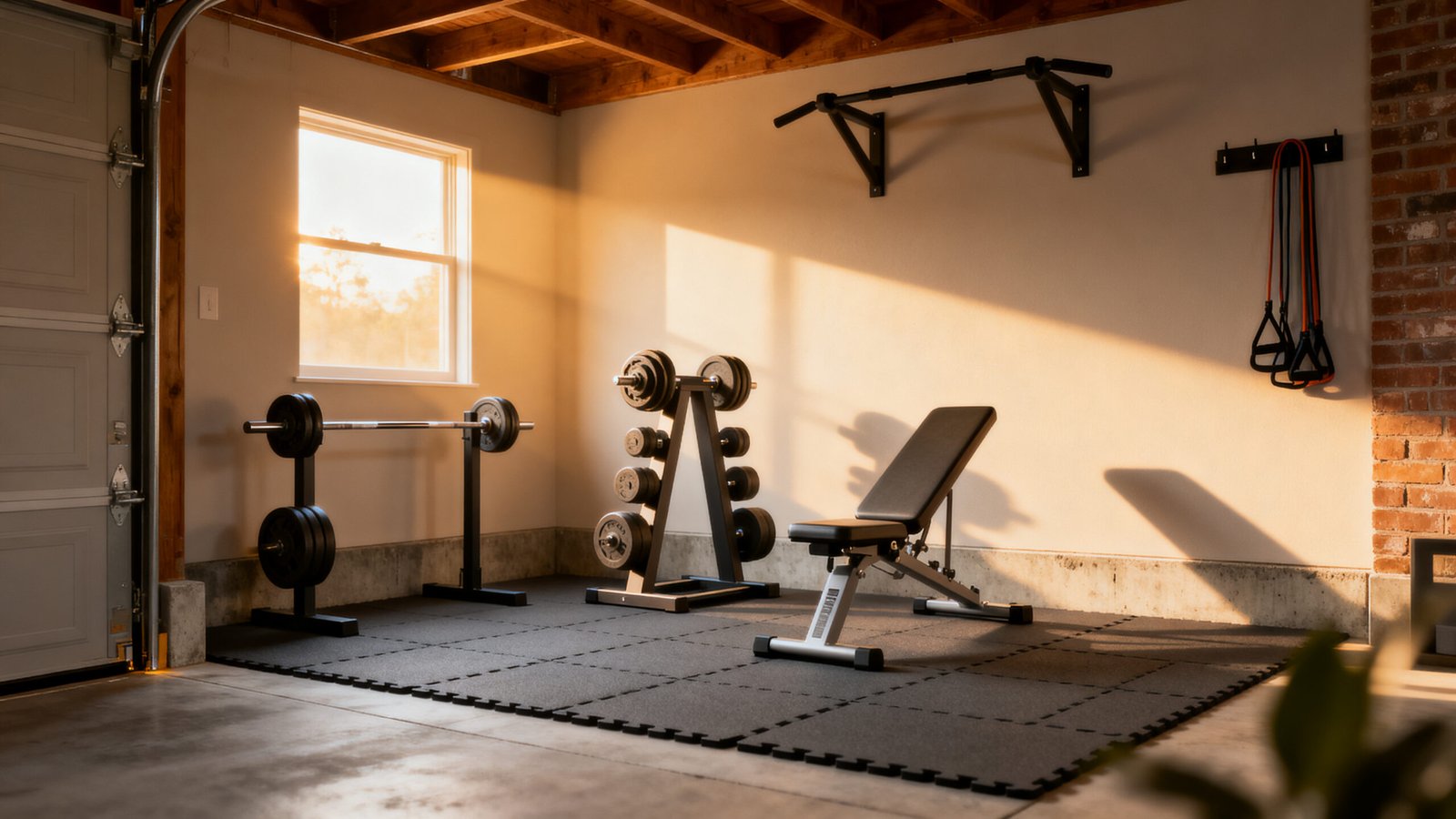
If you are shopping for a budget home gym setup, the market trends matter. More demand means more options at every price point. But it also means more noise. A clear, goal-driven home gym essentials list cuts through that noise fast.
The Single Most Important Item for Your Home Gym
If you can only buy one thing, make it a barbell and weight plates or a quality pair of adjustable dumbbells. The choice depends entirely on your primary goal and available space.
Barbells and plates are the number one most used home gym tool at 69 percent usage, based on survey data from Garage Gym Experiment. They transfer directly to strength training, hypertrophy work, and even conditioning when used for complexes or light barbell circuits. A single barbell plus a set of starter plates lets you squat, deadlift, press, row, and clean. No other single piece of equipment covers that many movement patterns.
Adjustable dumbbells are the smarter pick if your space is tight or your goal leans toward general fitness over pure strength. They take up a fraction of the footprint, allow for fast weight changes, and still support a full body routine. The tradeoff is maximum load. Most adjustable dumbbells top out between 50 and 90 pounds per hand, which is plenty for hypertrophy but limiting for heavy lower body work.
For a deeper dive into prioritizing purchases on a tight budget, check our home gym under 500 guide that walks through tradeoffs in detail.
A Goal-Based Home Gym Essentials Checklist
Your home gym essentials list should change based on whether you train for strength, cardio, or recovery. Below are three prioritized checklists at the Starter, Intermediate, and Compact tiers for each goal. Core items are non-negotiable. Secondary items add variety. Optional items are nice to have once your foundation is solid.
Strength Focus
Starter: Barbell, weight plates (starting at 160-260 lbs total), flat or adjustable bench, squat rack or squat stands.
Intermediate: Add adjustable dumbbells, resistance bands for warmups and mobility, and a pull-up bar.
Compact: Adjustable dumbbells, adjustable bench, resistance bands, pull-up bar, floor mats.
Cardio Focus
Starter: Rowing machine or air bike, jump rope, floor mats.
Intermediate: Add a treadmill or elliptical, plus a heart rate monitor for zone training.
Compact: Folding treadmill or under-desk walking pad, jump rope, resistance bands for cross-training.
Recovery and Mobility Focus
Starter: High-density foam roller, lacrosse ball, yoga mat, resistance bands (light and medium).
Intermediate: Add a percussion massage device and an adjustable bench for assisted stretching.
Compact: Mini foam roller, set of three resistance bands, yoga mat.
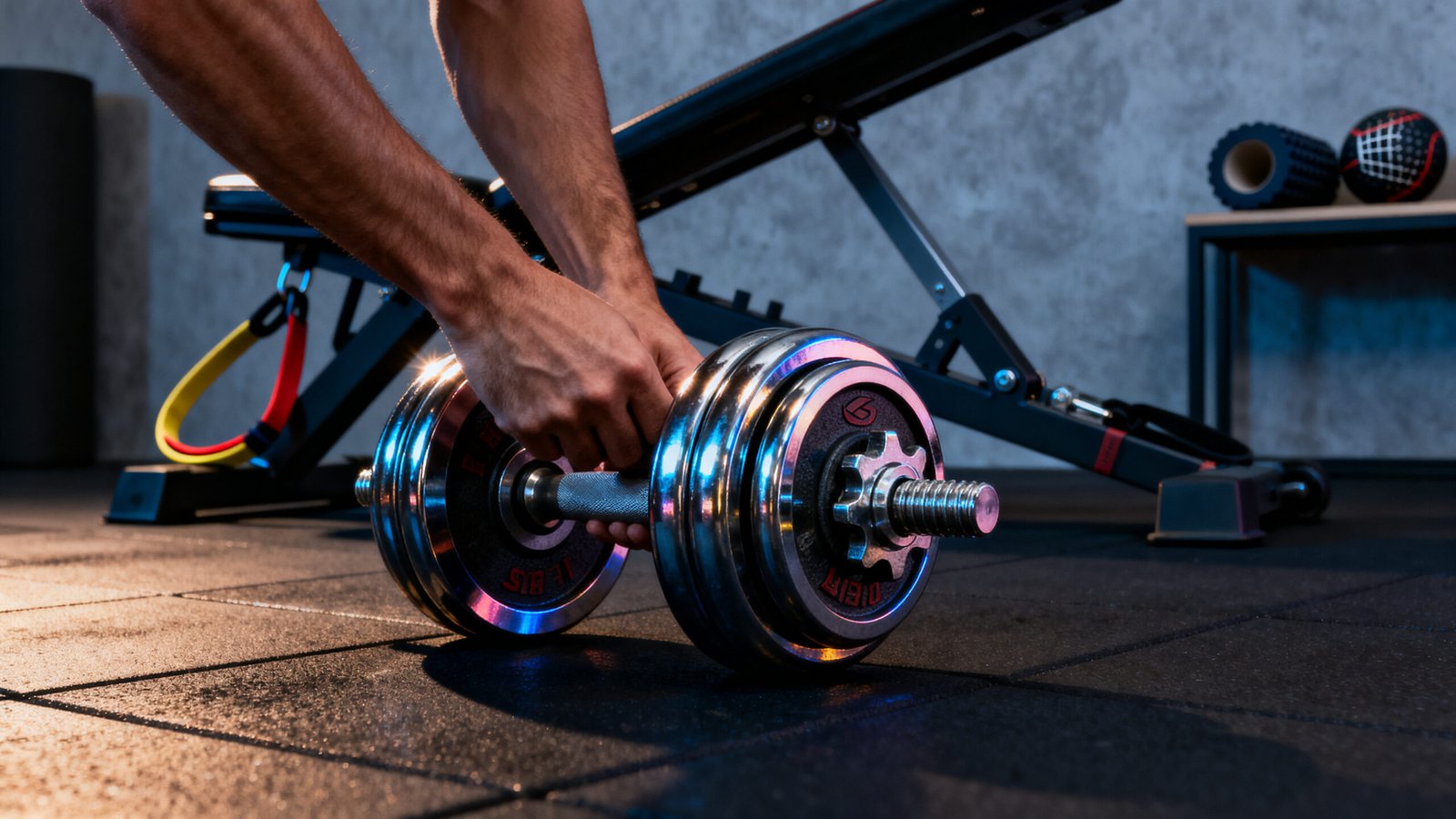
Strength equipment dominates market reports because it anchors most home gyms. Even a cardio-focused setup benefits from some resistance work. The reverse is also true. A complete home gym under 500 dollars is achievable if you stick to the starter tier and buy strategically.
The Compact Starter Kit: Your First 6 Items
If you want one shopping list that works for most beginners with limited space, here it is. This assumes a general fitness goal and a budget-conscious approach. Every item was chosen because it enables multiple movement patterns in a small footprint.
- Adjustable dumbbells (50+ lbs per hand): Replaces an entire rack of fixed dumbbells. Look for a quick-change mechanism and a flat-sided design that sits stable on the floor.
- Adjustable bench: Must go flat and incline. Decline is optional but nice. Check the weight capacity rating before buying.
- Resistance bands (set of three to four): Light, medium, heavy, and extra heavy. Use them for warmups, assisted pull-ups, banded squats, and mobility drills.
- Pull-up bar: Doorway mounted or wall mounted. Non-negotiable for back development. If doorframe models feel unstable, invest in a wall-mounted version with proper anchors.
- Floor mats (minimum 3/8 inch thick rubber): Protects your floor, reduces noise, and defines your training zone. Do not skip this or you will regret it after the first deadlift session.
- Cardio option: A rowing machine is the best space-to-benefit ratio. A folding treadmill works if running is your preference. An air bike is brutally effective for conditioning in a tiny footprint.
This kit covers strength, conditioning, and mobility in roughly 50 to 80 square feet. It also leaves room in your budget for the hidden costs most lists ignore. Speaking of which, our affordable home workout equipment guide breaks down exact pricing for each tier.
Budget Tiers and Hidden Costs Most Buyers Miss
Published equipment prices are misleading. They exclude shipping, flooring, assembly tools, wall anchors, and the extra weight plates you will inevitably need. Based on market signals and user spending patterns, here are realistic budget tiers.
| Tier | Equipment Budget | Hidden Costs (Estimate) | Realistic Total |
|---|---|---|---|
| Bare Minimum | $500 to $800 | $75 to $150 | $575 to $950 |
| Balanced | $800 to $2,000 | $150 to $350 | $950 to $2,350 |
| Semi-Pro | $2,000 to $5,000 | $300 to $700 | $2,300 to $5,700 |
Hidden costs include rubber flooring at roughly $1.50 to $3 per square foot, shipping fees for heavy items (freight shipping on a squat rack can run $150+), basic tools like socket wrenches and hex keys, wall anchors for pull-up bars, and the extra weight plates you will need as you get stronger. About 38.6 percent of US home fitness users spent under $500 on a single piece of equipment, per industry statistics, which shows how budget-sensitive most buyers really are.
For context, premium all-in-one systems like Tonal 2 run $4,295, while budget alternatives exist at a fraction of that. The gap between bare minimum and semi-pro is massive. A cheap home gym equipment approach works if you accept used gear and skip the extras.
Space, Layout, and Safety Requirements
Here is the uncomfortable truth. We could not find a single public source that aggregates manufacturer minimum guidelines for square footage, ceiling height, or clearance zones across squat racks, adjustable benches, and treadmills. Not one.
What we can tell you from practical experience and scattered manufacturer specs is this. A standard 7-foot barbell needs roughly 8 feet of width for comfortable loading and unloading. Ceiling height for overhead pressing should be at least 8 feet, and 9 feet is safer if you are tall or plan to do standing overhead work. Treadmills need about 6.5 feet of length and 3 feet of width for the unit itself, plus clearance behind the belt in case of a fall. Adjustable benches need roughly 6 by 3 feet of clear floor when in use.
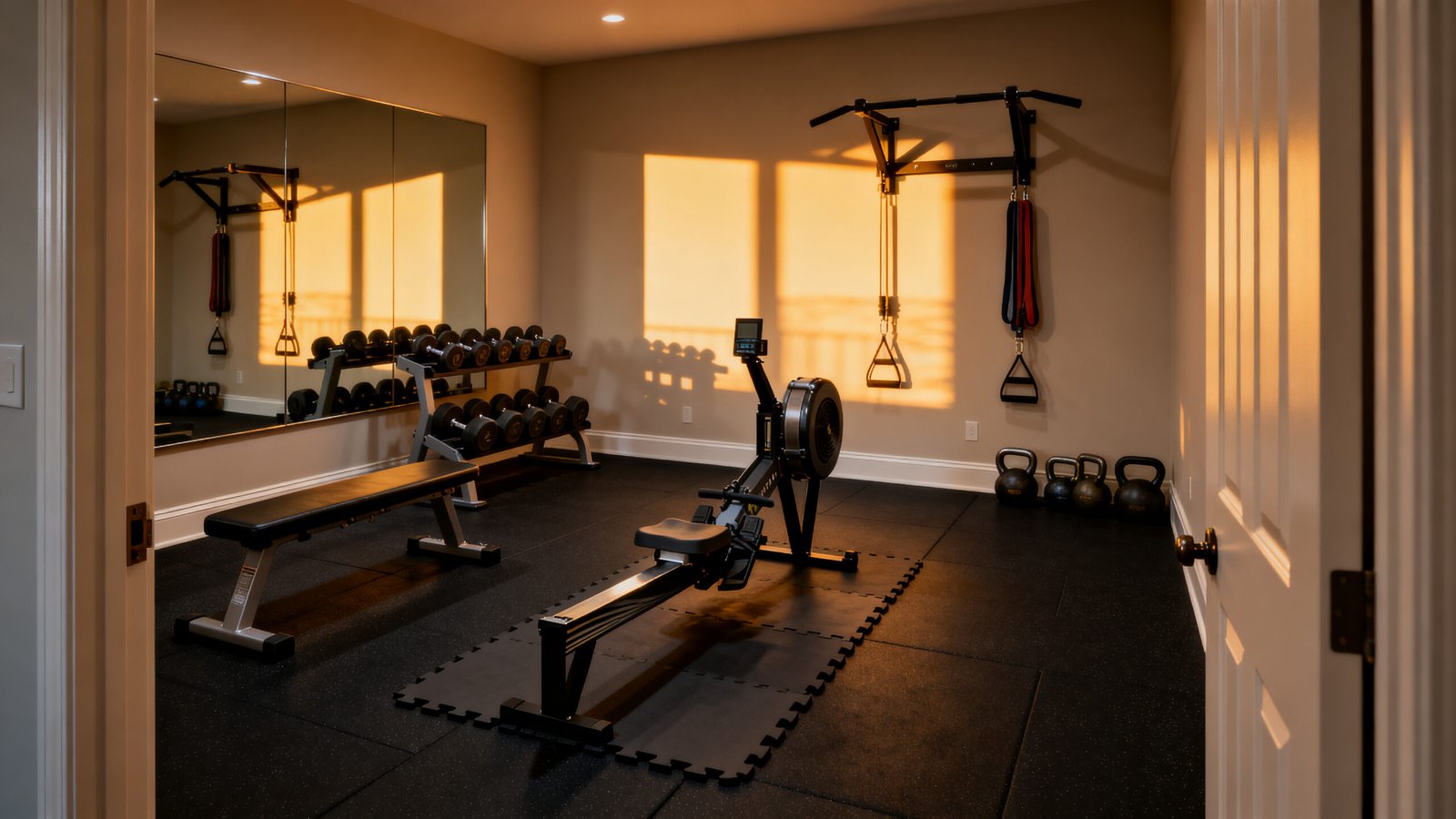
For a combined strength and cardio setup in a single room or garage bay, plan for at least 80 to 120 square feet of dedicated training space. Anything less and you will be constantly moving equipment around between exercises, which kills workout momentum. Mount a mirror on one wall for form checks and use wall-mounted storage for bands, belts, and accessories to keep the floor clear.
What Consumers Complain About Most
We attempted to find a consolidated list of the top three most common complaints in negative reviews for home gym starter kits on Amazon. It does not exist publicly. No research firm or review aggregator has published this data in an accessible format.
From manual spot checks across popular listings, recurring pain points include poor assembly instructions with missing hardware, benches that wobble under loads well below their stated capacity, and adjustable dumbbells with plastic locking mechanisms that fail after six to twelve months of regular use. Some budget squat racks arrive with bent uprights or misaligned bolt holes, making assembly a two-person frustration project.
These are not rare edge cases. They are pattern-level problems that the best home gym essentials list should warn you about. Until we complete our own original data collection on Amazon review themes, treat any product with a warranty shorter than one year as a red flag.
Technical Specs That Separate Budget from Mid-Range Gear
No public database compares technical specs across budget and mid-range home gym equipment at the level of detail buyers actually need. We searched for aggregated data on weight capacities, frame steel thickness, noise levels, and durability test results. It is scattered across individual product pages at best.
Here is what to check before you buy anything with a load bearing function. Look at the steel gauge or thickness on racks and benches. 11-gauge steel is standard for mid-range racks. 14-gauge is common on budget models and noticeably thinner. Weight capacity ratings should have a safety factor built in. A bench rated for 600 pounds is safer than one rated for 400 if you are benching 250 plus your body weight. For cardio equipment, belt-drive systems on treadmills are quieter and require less maintenance than motor driven friction setups. Rowing machines with magnetic or water resistance tend to outlast air resistance models in home use.
The price threshold where quality drops is blurry but generally sits around the $300 mark for benches, $500 for racks, and $700 for cardio machines. Below these thresholds, expect thinner materials, shorter warranties, and more assembly headaches.
Research Gaps We Plan to Fill With Original Data
This article is transparent about what we could not verify from public sources. Here are the six specific data gaps that prevent any home gym essentials list from being truly definitive right now.
- 2024/2025 category sales and return rates from major retailers across the top ten equipment categories. Market level figures exist but granular, category specific data does not.
- Top three negative review themes from Amazon starter kit pages. No consolidated analysis has been published.
- Aggregated minimum space and ceiling height guidelines from manufacturers for squat racks, benches, and treadmills. Each brand publishes its own specs or none at all.
- 50+ real user budgets from Reddit and Facebook groups that track total cost including hidden expenses. The 38.6 percent stat on single piece spending is useful but incomplete.
- Certified personal trainer priority rankings for equipment by training goal. Usage data from surveys exists but formal CPT ranked lists do not.
- Technical spec thresholds with lab or durability test summaries that clearly separate budget from mid-range quality. Independent testing data is not aggregated anywhere public.
We are actively collecting this data through reader surveys, manufacturer outreach, and manual review aggregation. When complete, this page will be updated with original findings that no other ranking article has.
Your Home Gym Essentials List: Final Verdict
A home gym essentials list is only as good as the goal it serves. Start with the single most important item for your training style. Build a starter kit around it using the six item checklist above. Budget for the hidden costs that every shopping list omits. Check steel gauge, warranty length, and real user reviews before you commit. And recognize that some of the most important data points in this space still do not exist publicly, which means cautious, modular buying beats all-in-one hype every time.
Download our annotated shopping list with price ranges and our simple floor plan template from the resources section below. It includes exact dimensions, material specs, and a checklist you can print and take to any retailer. If you want to start with a tighter budget, our home gym equipment package deal guide has targeted recommendations under $500. For a quote from a certified personal trainer on how they prioritize equipment by goal, check the updated version of this page next month when our CPT survey results go live.
Frequently Asked Questions
What is the number one piece of equipment for a home gym?
A barbell and weight plates is the most used piece of equipment at 69 percent usage among home gym owners. It supports squatting, deadlifting, pressing, rowing, and Olympic lifting variations. For compact spaces, adjustable dumbbells are a close second and more practical.
How much does a realistic beginner home gym cost?
Plan for $575 to $950 at the bare minimum tier, $950 to $2,350 for a balanced setup, and $2,300 to $5,700 for a semi-pro home gym. These figures include hidden costs like flooring, shipping, assembly tools, and extra weight plates that most equipment lists ignore.
Can I build a home gym for under $500?
Yes, if you buy used weight plates, stick to adjustable dumbbells instead of a barbell setup, use a doorway pull-up bar, and skip cardio machines in favor of a jump rope. Floor mats are still non-negotiable. Expect to make compromises on load capacity and long term durability at this price point.
What is the minimum space needed for a home gym?
For a combined strength and cardio setup, plan for 80 to 120 square feet of dedicated training space. A barbell alone needs about 8 feet of width. Ceiling height should be at least 8 feet, and 9 feet if you plan to press overhead. Treadmills need roughly 6.5 by 3 feet plus rear clearance.
Which is better for a home gym: adjustable dumbbells or a barbell?
Adjustable dumbbells are better for compact spaces, general fitness, and fast workout transitions. A barbell is better for maximal strength development and heavy lower body training. If you have the space and prioritize strength, get both. Start with the one that matches your primary goal.