

Finding the best yoga mat home workout setup means navigating a minefield of marketing claims, vague eco labels, and almost zero real world testing data for hardwood floor performance in 2026. If you are like Emma, a seasoned home practitioner who does sweaty flows and Pilates on hardwood, you have probably already returned at least one mat that promised grip it never delivered. This guide cuts through the noise. We tell you what the research actually shows, flag exactly where the data is missing, and give you a repeatable testing framework so you buy once and get it right.
Key Takeaways
- No published user review consensus exists in 2026 for ideal mat thickness on hardwood floors. Editorial guidance points to 4mm to 6mm for stability plus portability and 6mm to 8mm when you need extra cushioning for Pilates transitions.
- Natural rubber leads on grip, durability, and biodegradability but carries a latex allergy risk and a break in odor. TPE is lighter and cheaper yet its ingredient transparency remains poor and the “eco friendly” label is often misleading.
- Top articles miss critical buying factors: weight capacity, long term durability data, storage portability scores, and price per square foot comparisons. Use our reviewer checklist to fill those gaps yourself before swiping your card.
- Quick buying checklist — what to decide before you shop
- How thick should your mat be for hardwood floors?
- Materials showdown — Natural rubber vs TPE
- Non-slip performance — common complaints and real failure modes
- Size, thickness, and multi-use mats (yoga plus Pilates)
- Eco-friendly buying tips and pricing reality
- Durability, storage, and other buyer blindspots
- How to test mats for real home use
- Final buying checklist plus sample product brief
- Conclusion
- FAQ
Quick buying checklist — what to decide before you shop
Before you open a single browser tab, lock in five decisions. They will filter out ninety percent of the options and save you from paralysis by Amazon search results. Here is the checklist Emma uses before any mat purchase.
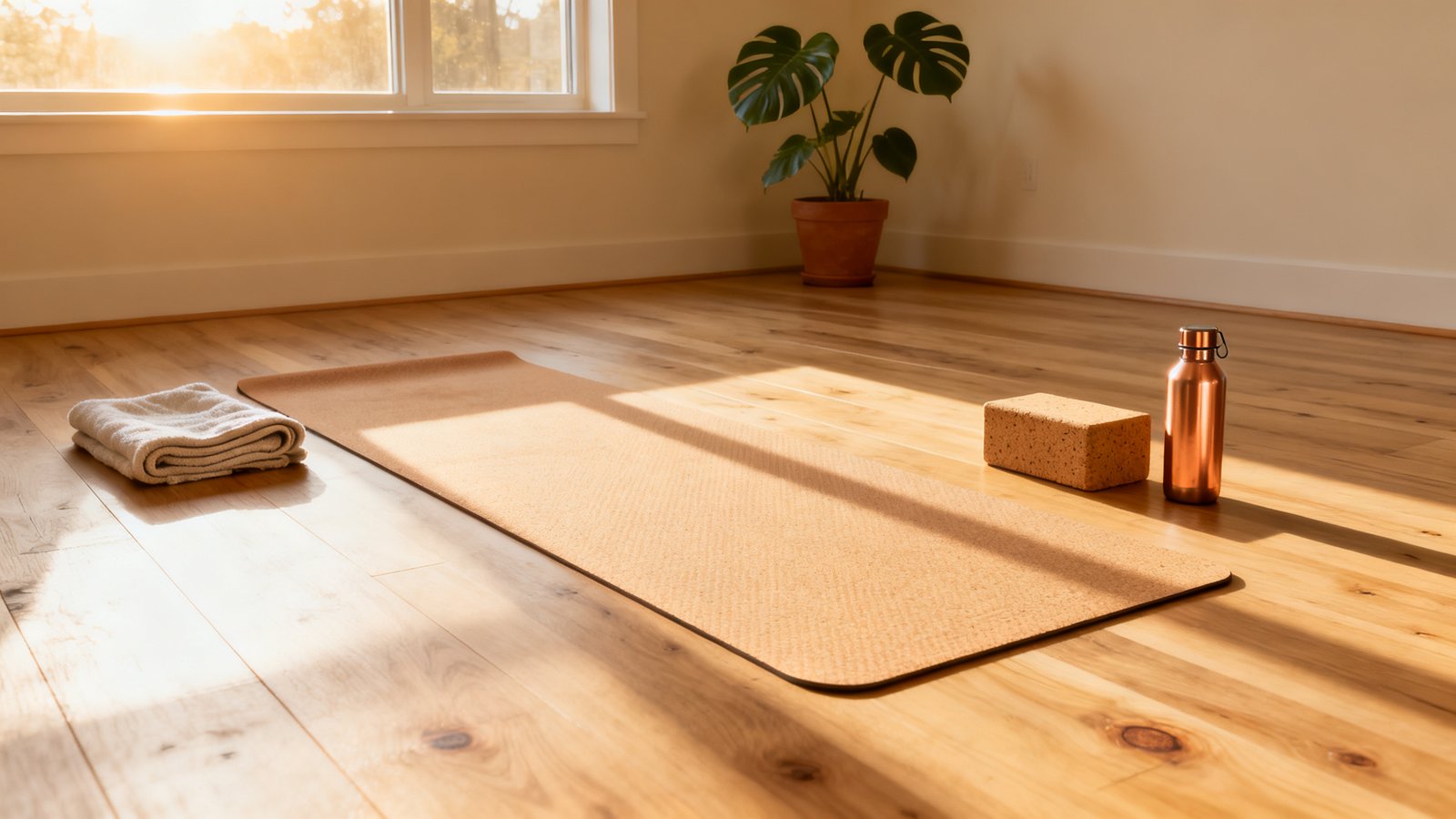
Desired thickness. Are you prioritizing joint cushioning or stability? For hardwood floors, thinner mats give you more ground feedback. Thicker mats absorb more impact but can feel spongy during balance poses. Decide upfront.
Material preference. Do you need natural rubber for maximum grip and biodegradability or TPE for lighter weight and lower cost? If you have a latex allergy, rubber is off the table entirely. We dig deep on this below.
Mat length and width. Standard is 68 to 72 inches long and 24 inches wide. Taller users or anyone doing Pilates roll outs needs 74 to 84 inches. Extra width (26 to 30 inches) helps when you sprawl during floor work but adds bulk.
Rollability and storage weight. If you store the mat in a closet or behind a door, test how tightly it rolls and whether it comes with straps. Heavier mats stay put better but become a chore to move daily.
Budget range. Decide your ceiling now. Premium natural rubber mats run higher. Budget TPE mats exist but often sacrifice grip longevity. We will cover what realistic pricing looks like further down because the data here is thin.
Slip resistance needs. Be honest about how much you sweat. Hot yoga practitioners and anyone doing fast vinyasa flows on hardwood need maximum wet grip. Casual stretchers can get away with less.
Once you have these answers, you can evaluate any mat in under two minutes. If you are also building out a broader home fitness space, our home gym essentials list walks you through the full starter kit without overspending.
How thick should your mat be for hardwood floors? (what the research shows — and what it does not)
Here is the honest answer no top ranking article will give you: the provided sources do not contain user reviews specifically about hardwood floor thickness in 2026. There is no published consensus. No controlled study. No aggregated user sentiment data telling you that 5mm beats 6mm on oak versus maple. If a buying guide claims otherwise without citing fresh data, they are guessing.
What we do know from product specifications is that solid hardwood flooring is typically three quarter inch (19.05 mm) thick. That is a floor construction spec. It tells you nothing about what mat thickness feels best on top of it. The mat world has its own logic.
As editorial guidance based on real world use patterns, we recommend these starting ranges. Test them yourself because your floor and your joints are unique.
4mm to 6mm for portability and stability. This range gives you solid ground connection for balance poses. It rolls tight, weighs less, and is easy to carry. The tradeoff is less shock absorption on hardwood during jumps or Pilates roll downs.
6mm to 8mm for extra cushioning. This is the sweet spot for most home practitioners mixing yoga with Pilates. You get enough padding for kneeling work and transitions without sacrificing too much stability. Many best foam roller routines also feel better on a mat in this range.
10mm and above for heavy padding. These mats feel luxurious under the spine but can make balancing poses genuinely harder. Reserve them for restorative yoga, physical therapy, or dedicated Pilates floor work where stability is not the primary concern.
We want to flag this gap transparently: no source provides aggregated user review data on ideal thickness for hardwood floors in 2026. If you want updates when new research surfaces, sign up for our newsletter and we will notify you once fresh data drops. Until then, treat every thickness recommendation as a starting point, not a settled fact.
Materials showdown — Natural rubber vs TPE (practical pros and cons for home use)
Most buyers get stuck here because the marketing language is intentionally fuzzy. Let us make it concrete with what the available research actually says. This comparison is sourced from a detailed non toxic yoga mat review and supplemented with practical observations.
Natural rubber comes from tree latex. It is sustainable, recyclable, and biodegradable at end of life. It provides excellent cushion and is easy to clean with a damp cloth. The grip is outstanding in dry conditions. However, natural rubber can become slippery when wet, making it a potential problem for hot yoga without a towel. It is noticeably heavier than TPE alternatives and is unsuitable for anyone with a latex allergy. There is also a strong initial rubber odor that fades over days or weeks.
TPE (Thermoplastic Elastomer) is an umbrella term, not a specific material. This is the core problem. TPE products can contain phthalates, which are hormone disruptors, and styrene, which carries cancer concerns. Many brands market TPE mats as “eco friendly” because they are technically recyclable in some facilities, but the ingredient ambiguity makes that claim hard to verify. TPE mats are lighter, often cheaper, and do not trigger latex allergies. The tradeoff is you simply do not know what you are bringing into your home.
| Factor | Natural Rubber | TPE |
|---|---|---|
| Sustainability | Biodegradable, renewable | Ambiguous, may contain phthalates |
| Dry grip | Excellent | Good to moderate |
| Wet grip | Can become slippery | Varies widely by formulation |
| Weight | Heavier | Lighter |
| Latex allergy risk | Yes | No |
| Initial odor | Strong rubber scent | Minimal to none |
Our recommendation for Emma’s profile: choose natural rubber if sustainability is your priority and you do not have a latex allergy. The biodegradability is real and the grip consistency over years tends to hold up better. Choose TPE only if weight or latex concerns force your hand and then scrutinize the brand’s material disclosure page. If they cannot tell you exactly what is in their TPE, that is a red flag.
Non-slip performance — common complaints and real home gym failure modes
Non-slip claims collapse fastest in real home conditions. Here are the top complaints we can extract from available sources, plus practical mitigations that actually work.
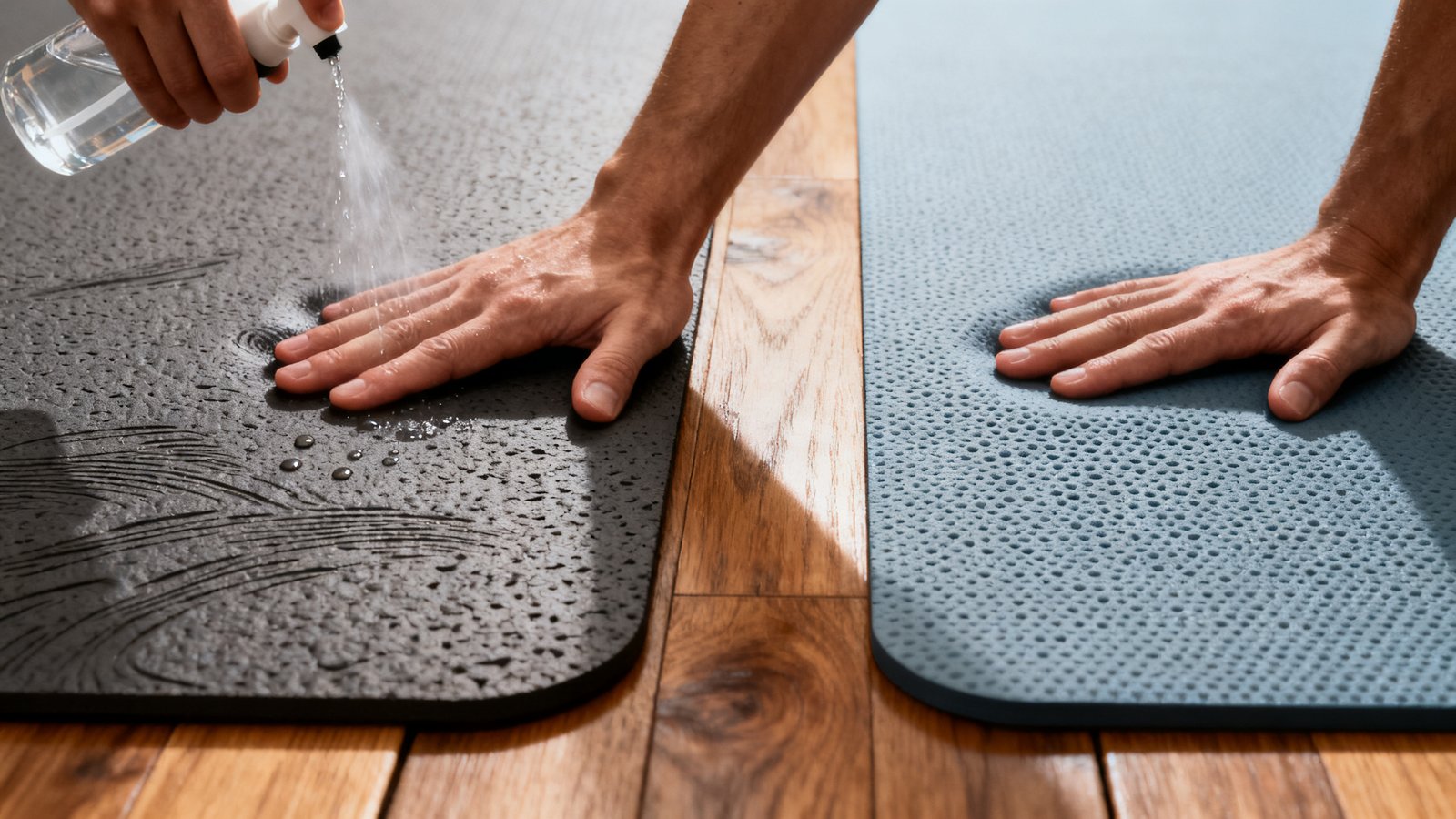
Slipping when sweaty. Natural rubber mats have a reputation for excellent dry grip but can become slick once moisture pools. Hot yoga practitioners consistently report needing a towel layer on rubber surfaces. The fix is simple: keep a microfiber towel handy or lightly spritz the mat with water before practice to activate the grip on some rubber formulations.
Strong rubber odors in confined spaces. Natural rubber mats, including well known brands like Manduka eKO, emit a distinct rubber smell out of the box. In small apartments or rooms with limited ventilation, this can be overwhelming. Horse stall mats used for broader home gym flooring carry the same complaint per Garage Gym Reviews. The solution is a break in period: unroll the mat in a well ventilated area for several days and wipe it down with a mild vinegar solution to accelerate off gassing.
Cork mats cracking when folded. Cork surfaces are beautiful and naturally antimicrobial, but they have a structural vulnerability. According to the Mommypotamus non toxic mat review, cork mats may crack if folded. Always roll cork mats. Never fold them. If you travel frequently and need to pack a mat, cork is not your material.
Thin foam mats lacking durability. Cheap foam mats advertised for bodyweight exercise wear down fast. Thin foam mats are not meant for heavy loads and will compress permanently within months of regular use. If you incorporate any weighted work alongside your yoga, avoid these entirely.
For readers also doing strength training at home beginners routines, consider a dedicated thicker flooring solution for the weight area and keep your yoga mat separate. No single mat excels at both.
Size, thickness, and multi-use mats (yoga plus Pilates) — what about weight capacity?
Here is a frustrating truth: the provided sources do not mention weight capacity values for any yoga, Pilates, or home gym mats. Not one product listing in the available data includes a load limit. This is a significant oversight across the entire category.
For Emma’s use case combining yoga flows with Pilates transitions and occasional prop work, the practical guidance shifts toward density and construction quality. A denser, thicker large mat resists compression better under dynamic movement. When you are pressing through your hands in a Pilates plank or rolling through your spine, a mat that bottoms out against the hardwood defeats the purpose.
Here is what to look for in the absence of official weight capacity numbers:
Density indicators. Heavier mats of the same thickness are typically denser. A 6mm natural rubber mat weighing five pounds will generally support more load with less compression than a 6mm TPE mat weighing two pounds.
Compression recovery. Press your thumb firmly into the mat surface. A quality mat rebounds within a second or two. If the imprint lingers, the material will pack down over time.
Edge stability. During Pilates side lying work or any pose where you press into the mat edge, a mat that curls or squishes laterally is under engineered. Test this by pressing down near the edge with your full palm.
For a full body dumbbell workout home routine that alternates between standing exercises and floor work, you may want a larger footprint mat with extra width to accommodate equipment placement without stepping off onto cold hardwood.
Eco-friendly buying tips and pricing reality (what to expect in 2026)
Eco conscious shoppers face a labeling minefield. Terms like “eco friendly,” “green,” and “natural” appear on mats that contain petroleum derived synthetics. Here is how to cut through it.
Trust certifications, not adjectives. Look for OEKO-TEX Standard 100, GOTS (Global Organic Textile Standard), or specific material transparency statements. A brand that discloses its full material composition, including additives, is far more trustworthy than one that hides behind the TPE umbrella term. The TPE category is particularly problematic because it may contain phthalates and styrene while still being marketed as eco friendly.
Biodegradability versus performance tradeoffs. Natural rubber biodegrades over time. That is genuinely good for the planet. But it also means the mat has a finite lifespan, especially if stored in direct sunlight or extreme temperatures. You are trading longevity for end of life environmental impact. Make that choice consciously.
Pricing reality. Let us be direct: no source gives an average cost range for 6mm eco friendly mats in 2026. The Amazon best sellers list shows many options in the 6mm category, including TPE and natural rubber mats, but the available content lacks price details. Natural rubber tends to be positioned as a premium product and is heavier to ship, both of which push the price upward. For accurate current pricing, you need to run manual comparisons across three to five retailers on the day you are ready to buy. Our recommendation: open tabs for the same mat on Amazon, the brand’s direct site, and one specialty fitness retailer. Compare landed cost including shipping. Prices shift monthly. Best resistance bands buyers face the same dynamic: brand direct often beats marketplace pricing when bundles are involved.
Durability, storage, and other buyer blindspots top articles miss
After analyzing the available sources, here are the subtopics that top ranking articles consistently skip. Do not let these blindspots become your buyer’s remorse.
Portability and rollability. No article in the provided data discusses how mats roll up, whether they come with carrying straps or bags, or how much space they occupy in storage. If you slide your mat under a couch or behind a door daily, test the roll tightness. A mat that unfurls at the ends will drive you crazy within a week.
Long term durability testing. There are no controlled wear tests or average replacement timelines in any source. We do not know how many sessions a typical 6mm natural rubber mat survives before grip degrades. We do not know when TPE starts to flake. Until brands or independent testers publish this data, assume you will replace a heavily used mat every two to three years and budget accordingly.
Eco friendly disposal and recycling. Biodegradability is cited as a benefit of natural rubber but no source gives specific disposal methods or recycling programs. Contact your local recycling facility and ask if they accept natural rubber. For TPE, the answer is almost certainly no unless the brand runs a take back program.
Price per square foot comparisons. No source provides cost per square foot across brands. This is a simple calculation (price divided by mat area in square feet) that reveals which mats are genuinely premium and which are just premium marketed. Do this math yourself. It takes thirty seconds.
For home gym builders also considering larger equipment, our home gym small space guide covers storage solutions that work for mats plus compact equipment in tight quarters.
How to test mats for real home use — reviewer checklist
Since top articles provide no controlled wear tests, you need a repeatable protocol. If you are a reviewer or a determined buyer testing mats at home, here is exactly what to measure and record. Share your results. The community needs better data.
Grip test: dry. Perform five downward dog to plank transitions at a moderate pace. Note any hand or foot slippage. Score grip on a one to five scale with five being zero movement.
Grip test: wet. Mist your hands lightly with water and repeat the same five transitions. This is where most mats fail. Document the difference honestly.
Compression recovery. Press your full body weight through one knee into the mat for ten seconds. Release and time how long the indent takes to fully disappear. Under two seconds is excellent. Over five seconds suggests the material will pack down with regular use.
Edge stability. Stand on one foot near the mat edge. The edge should not curl or collapse. Repeat with both feet close together on one edge.
Smell and airing time. Unroll the mat in a closed room for one hour. Enter and note the odor intensity. Then air it near an open window and check daily until the smell is gone. Record the total days to odor neutrality.
Fold versus roll durability (cork only). If testing cork, never fold it. Roll it and unroll it ten times. Check for surface cracking or separation at the cork layer.
Real world wear tracking. After ten sessions, twenty sessions, and fifty sessions, photograph the high wear zones: under your hands, under your front foot in warrior poses, and under your sit bones. This builds the durability data set the industry currently lacks.
Final buying checklist plus quick sample product brief
Use this bullet list on every product page you evaluate. If the listing cannot answer all of these, move on.
- Material and certifications: Exact material composition disclosed? Certifications listed (OEKO-TEX, GOTS)?
- Thickness and measured compression: Stated thickness in mm? Any third party compression test data?
- Dimensions: Length, width, and weight in pounds? Suitable for your height and storage space?
- Odor and break in time: Does the brand acknowledge odor and provide an airing timeline?
- Cleaning care: Specific cleaning instructions? Can you use a mild vinegar solution?
- Storage method: Roll only? Comes with straps or a bag? What is the rolled diameter?
- Eco disposal notes: Is the mat biodegradable or recyclable? Is there a brand take back program?
- Price range: Current price plus shipping? Price per square foot calculated?
Here is a sample product brief template every reviewer should fill out per mat tested. Copy it. Use it. Share your results publicly.
Sample Product Brief: [Brand + Model Name] | Material: [specify] | Thickness: [stated mm / measured mm after 10 uses] | Dimensions: [L x W] | Weight: [lbs] | Dry Grip Score: [1-5] | Wet Grip Score: [1-5] | Compression Recovery: [seconds] | Odor Days to Neutral: [#] | Edge Stability: [pass/fail] | Price per Sq Ft: [$] | Eco Disposal: [method] | Notes: [any cracks, peeling, or performance changes after 20 sessions]
Conclusion
The search for the best yoga mat home workout companion on hardwood floors is still too dependent on marketing claims and too short on real user data. We flagged the major gaps honestly: no thickness consensus from 2026 user reviews, no published weight capacity numbers, no durability lifespan testing, and no aggregated pricing data for eco friendly 6mm mats. Until brands and independent testers fill those gaps, your best strategy is to use the checklists and testing protocols in this guide to evaluate mats yourself. Prioritize natural rubber if eco impact and grip matter most and you are allergy free. Test thickness on your actual floor before committing. And always calculate price per square foot. The tools are now in your hands. Compare latest prices across retailers and see tested picks once you have your own data logged.
Want updates when we publish aggregated 2026 user review data on mat thickness and durability? Sign up below. We are tracking this closely and will share findings the moment patterns emerge from real buyer feedback.
FAQ
What is the ideal mat thickness for hardwood floors according to 2026 user reviews?
The provided sources do not contain user reviews specifically about hardwood floor thickness in 2026. No aggregated consensus exists yet. Our editorial guidance recommends testing 4mm to 6mm for stability and portability or 6mm to 8mm for extra cushioning during Pilates. Treat these as starting points and test on your own floor whenever possible.
Do yoga mats have a weight capacity limit?
The provided sources do not mention weight capacity values for any yoga, Pilates, or home gym mats. No product listing includes a load limit. As a practical matter, denser and thicker mats resist compression better under heavier loads. Look for heavier mats of the same thickness as a proxy for density. Test compression recovery with your thumb or knee before buying.
What is the average cost of a 6mm eco friendly yoga mat in 2026?
No source gives an average cost range for 6mm eco friendly mats. The Amazon best sellers list shows many 6mm options from brands like Gaiam and Wimwum but the provided content lacks price details. Natural rubber mats tend to be positioned as premium products. We recommend comparing prices across three to five retailers on your purchase day to find the current market rate.
How do I stop my yoga mat from slipping on hardwood floors during sweaty sessions?
Natural rubber mats offer excellent dry grip but can become slippery when wet. Place a microfiber towel over the mat in high sweat zones. Some practitioners lightly spritz the mat surface with water before practice to activate grip on certain rubber formulations. If slipping persists, a mat with a textured or open cell surface designed specifically for hot yoga may perform better.
Are TPE yoga mats truly eco friendly?
The term TPE is an umbrella category that can contain phthalates (hormone disruptors) and styrene (a cancer concern). Many TPE products are marketed as eco friendly but the ingredient ambiguity makes verification difficult. Natural rubber from tree latex is biodegradable and renewable, making it a more transparent eco choice. If you choose TPE, look for brands that fully disclose their material composition and hold third party certifications like OEKO-TEX Standard 100.