

Adjustable vs fixed dumbbells is not a debate about which piece of iron is better in a vacuum. It is a math problem about your floor plan, your training future, and the real cost per pound of getting stronger in an apartment. Sarah knows this. She works from home, trains three times a week, and has a budget that tops out around $800. She needs one purchase that disappears when not in use and grows with her strength. If that sounds familiar, the answer leans heavily one direction, with a few honest exceptions we will lay out flat.
Key Takeaways
- One adjustable pair does the work of 15 to 30 fixed pairs while taking less than 2 square feet of floor space.
- The long term cost of fixed dumbbells hides in every new pair you buy when you get stronger, not in the first purchase.
- Adjustable dumbbells have real durability and feel tradeoffs you need to screen for before buying, especially with plastic components and re-racking alignment.
- Quick verdict: which to buy, and when
- How adjustable and fixed dumbbells differ in practice
- Pros and cons at a glance for real decision making
- The long term cost and space story competitors miss
- Warranties, replacement parts, and the 5 year question
- Real user complaints to watch for (from reviews and testers)
- Exact footprint and apartment planning numbers
- Buyer checklist: questions to ask before you buy
- Buying scenarios: which models fit which users
- How to test adjustable dumbbells in store or at home
- Conclusion
- Frequently Asked Questions
Quick verdict: which to buy, and when
If your home gym must live in a shared apartment, a home office corner, or a closet with less than 3 square feet of permanent floor space, buy an adjustable dumbbell set today and stop overthinking it. The math flips only when you have a dedicated garage or basement space, need Olympic-level micro-loading in 2.5 pound jumps, or genuinely enjoy the feel of a perfectly knurled fixed dumbbell and are willing to pay for it in both money and square footage. For Sarah and nearly everyone in a compact living setup, adjustable dumbbells are the financially smarter and logistically cleaner move. Fixed dumbbells become a luxury of floor space, not a budget win.
How adjustable and fixed dumbbells differ in practice
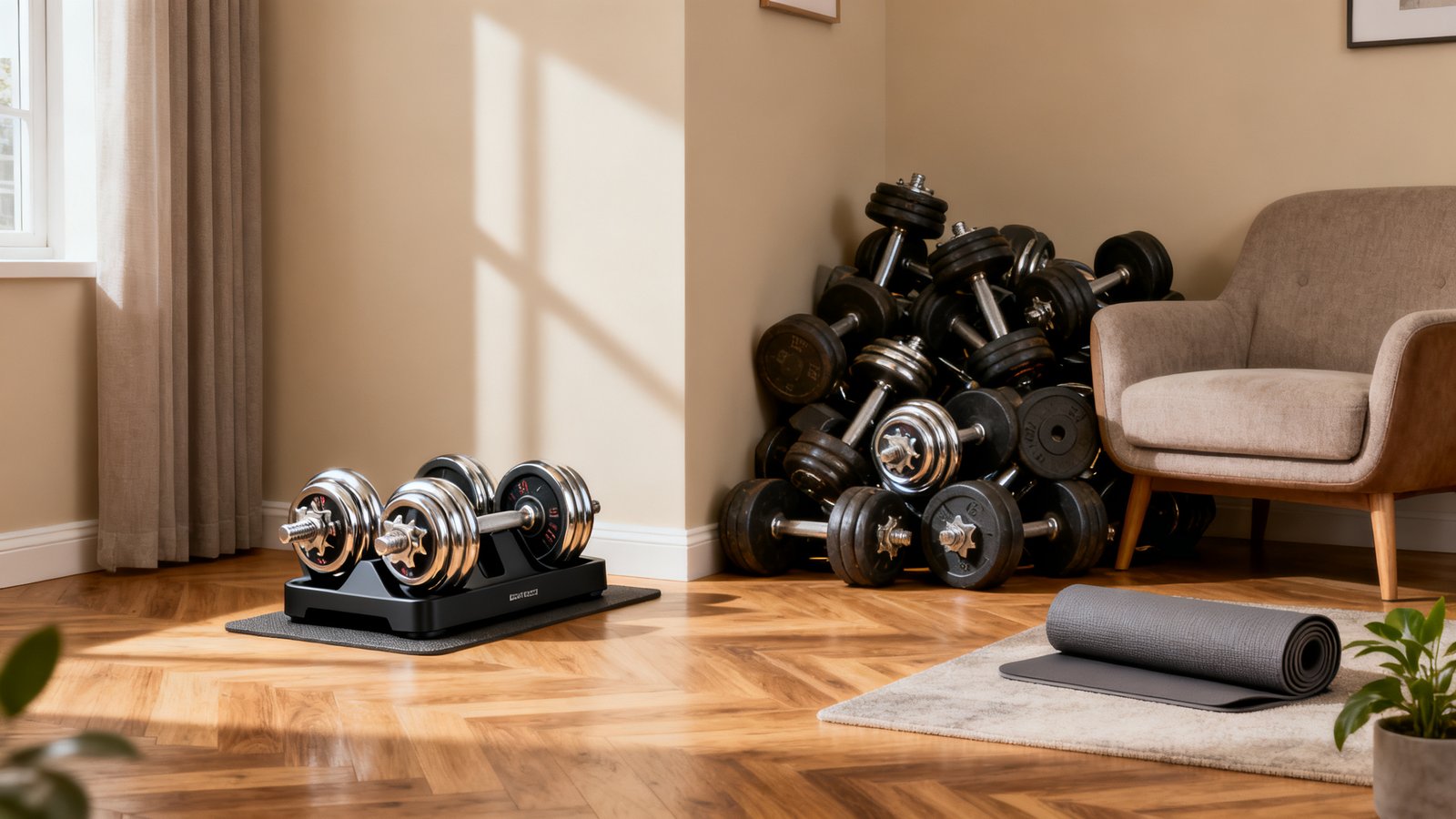
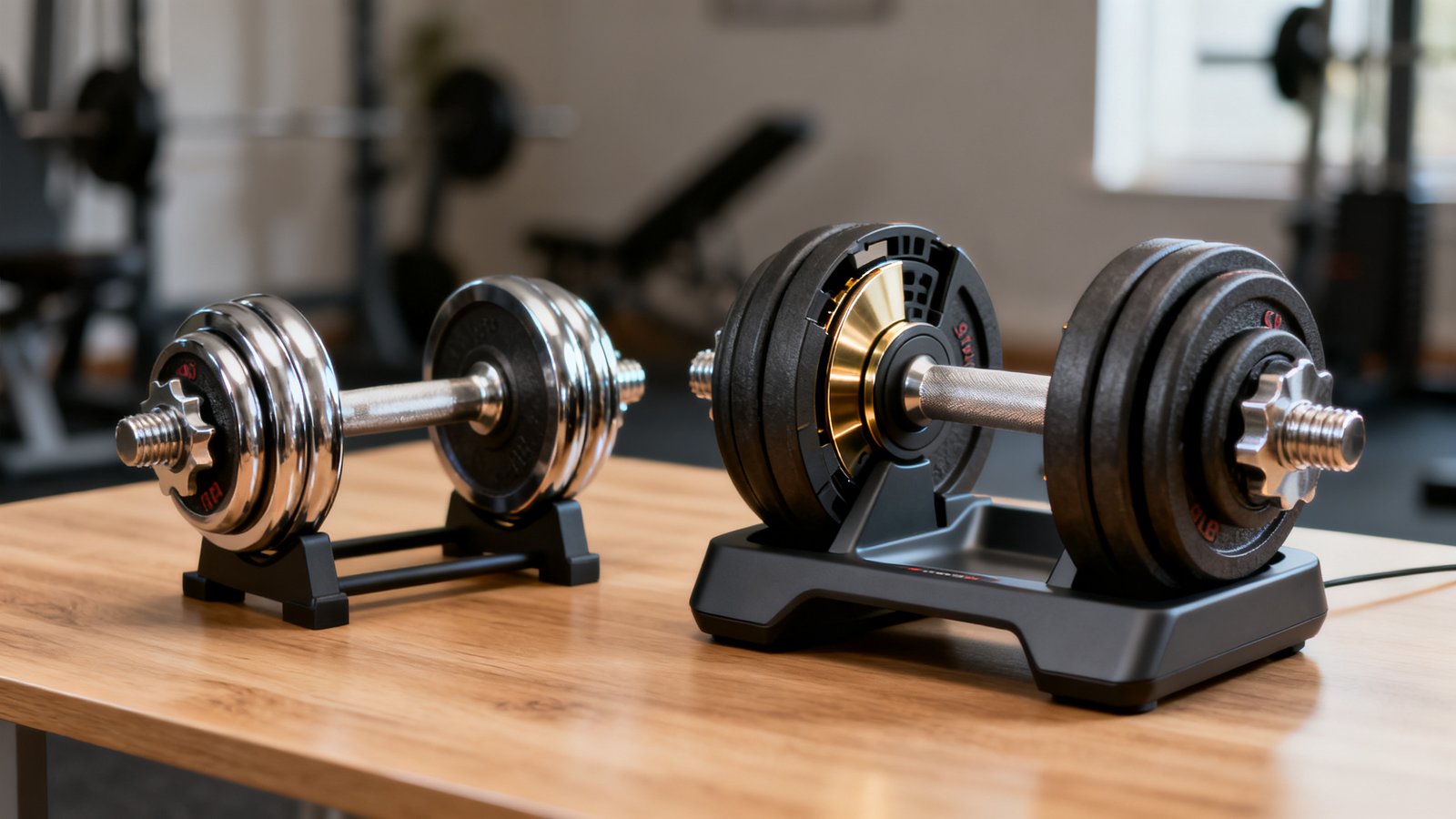
An adjustable dumbbells or regular fixed pair might both say 25 pounds on the label, but the experience holding them is not the same. Adjustable sets use a selector pin, dial, or twist mechanism to change weight plates inside a cradle. Fixed dumbbells are a single welded or cast unit. The footprint difference is staggering. A PowerBlock Pro 100 EXP pair on its cradle measures roughly 19.2 inches long by 7.6 inches wide by 7.7 inches tall, living comfortably under a desk or bed. A set of fixed dumbbells from 5 to 50 pounds typically sprawls across a 4 to 6 foot wide rack that eats 12 to 18 square feet once you add clearance to walk and lift.
Weight increments matter too. Many adjustable sets jump in 5 pound steps. Fixed pairs let you grab 2.5 pound increases if you buy them, but that means more physical pairs. Speed of change is another split. Dial systems like the Bowflex SelectTech are faster than manual pin loading, but still slower than simply dropping one fixed dumbbell and picking up another during a drop set. Durability also separates them. Fixed dumbbells are iron and knurling with almost nothing to break. Adjustable models carry moving parts, plastic housings, and locking mechanisms that reviewers at Garage Gym Reviews and Wirecutter repeatedly flag as failure points.
Pros and cons at a glance for real decision making
Stripping away marketing language, here is what actually matters for someone building a small home gym on a budget. These pros cons adjustable dumbbells lists come straight from tester feedback and owner interviews.
| Adjustable Dumbbells | Fixed Dumbbells |
|---|---|
| Pros: Replaces dozens of pairs, fits under a bed, one time purchase scales for years, total lifetime cost often lower, compact enough for apartments. | Pros: Instant weight changes, near indestructible, perfect balance and knurling, no alignment hassle, handles feel like a commercial gym. |
| Cons: Plastic parts can crack, bulkier shape feels awkward on some movements, re-racking must be precise, 5 pound jumps may stall micro-progression, maxes out at 50 to 90 pounds on common models. | Cons: Requires a dedicated rack that dominates a room, cost multiplies with every new strength level, no quick under-bed storage, moving apartments with them is a workout itself. |
The long term cost and space story competitors miss
Most adjustable vs traditional dumbbells home gym comparisons stop at the sticker price of one pair versus one pair. That is the wrong equation. Fixed dumbbells tempt you with a lower entry price, but as the NÜOBELL blog points out, that is a slippery slope. You buy 15 pound dumbbells for lateral raises. A month later you need 25s for curls. Six months later you are pressing 45s and eyeing 55s. Each purchase is another $40 to $120 and another 1 to 3 square feet permanently gone. Over two to three years, a fixed set for a progressing lifter can quietly cross $600 while consuming a corner of the room that never comes back.
Adjustable dumbbells are the one time investment that scales. Even a high end model like the NÜOBELL or PowerBlock Pro sits in the $500 to $800 range, covers 5 to 50 or 90 pounds, and still leaves you floor space for a yoga mat or a folding weight bench. This is the story most reviews gloss over because it unfolds over years, not in a 10 minute unboxing video. For Sarah, who wants one purchase and done, adjustable wins on both financial present value and space future value.
Warranties, replacement parts, and the 5 year question
Are adjustable dumbbells worth it over a half decade? Honest answer: we lack the full data because replacement part costs are not publicly itemized by brands. Warranties offer a partial signal. The REP x PÉPIN adjustable set carries a lifetime warranty. NÜOBELL offers 4 years. PowerBlock Pro 100 EXP gives 5 years. These numbers matter because moving parts wear out. A pin mechanism can get sloppy. Plastic cradles can crack if dropped.
Fixed dumbbells have almost no warranty risk because there is nothing to fail beyond cosmetic rust. With adjustables, you are betting on the warranty length to cover the unknown. If you buy a set with a 4 year warranty and treat it carefully on rubber mats, the risk profile is low enough for most home users. But call out the gap: no source provides a clean 5 year cost of ownership comparison including parts, and that absence should make you favor brands with documented support and easily reachable customer service.
Real user complaints to watch for (from reviews and testers)
Ignoring user complaints is how you end up with a $600 doorstop. Adjustable dumbbells or regular fixed ones both have gripes, but adjustable sets concentrate them around moving parts and plastic. Sources like Garage Gym Reviews, Shape, and Wirecutter report these repeat complaints:
- Plastic components on loadable parts crack under repeated drops.
- Cradles stick when picking up fully loaded dumbbells, especially on Core Home Fitness models.
- Re-racking requires careful alignment. Rushed reracks fail and jam.
- Internal rattling during presses or carries, audible on Bowflex SelectTech units.
- Weight jumps of 5 pounds feel too coarse when trying to add 2.5 pounds to a shoulder press.
- Some models, like NordicTrack, max out at 55 pounds, which intermediate lifters outgrow fast.
- Manual plate loading on budget models takes up to a minute per change, killing workout density.
Mitigation is straightforward. Choose models with metal weight plates and metal contact points where possible. Inspect the re-racking design in videos before buying. If you need 2.5 pound increments, check if the system supports add on weight kits. And if you are already pressing 60 pound dumbbells for reps, skip anything that caps at 55. These are the exact types of mistakes highlighted in the common home gym mistakes beginners make, and they sting even more in a small space.
Exact footprint and apartment planning numbers
A full fixed dumbbell rack with pairs from 5 to 50 pounds needs roughly 12 to 18 square feet once you factor in standing clearance and walkway. For an apartment living room that doubles as a gym, that is a nonstarter. An adjustable set with cradle, like the PowerBlock Pro 100 EXP at about 19 by 8 inches, uses under 1.6 square feet. Many stands and cases slide under a bed or into a closet in seconds.
When planning placement, leave at least 18 inches of clear floor on all sides of the cradle so you can load and unload without twisting your spine in a cramped corner. If you have hardwood floors, factor in a rubber mat that adds a few inches of footprint but protects both the floor and the dumbbell cradles. This is the kind of detail covered in the small apartment home gym guide, and it turns a tight corner into a functional lifting zone.
Buyer checklist: questions to ask before you buy
Should I buy adjustable or fixed dumbbells? Answer these five questions honestly and the decision makes itself.
- What is your current heaviest dumbbell lift for 5 reps? Add 20 pounds to that number. Does the adjustable set reach it?
- How many unoccupied square feet do you have right now, not after moving furniture? If under 20 square feet, fixed racks are out.
- Do you care about plastic parts and tighter alignment requirements? If you will drop weights or rush reracks, buy metal adjustable or go fixed.
- Do you need speed of change for drop sets and circuits? If yes, test the adjustment mechanism in person or watch unedited change videos.
- Is your budget a one time ceiling or an ongoing leak? A single $600 adjustable buy beats five $100 fixed pairs on total cost, every time.
If any answer pushes you toward adjustables, the home gym essentials list and what weight dumbbells should I buy guides can help you identify the exact weight ranges to cover your program.
Buying scenarios: which models fit which users
No single model wins for everyone. Here is how adjustable dumbbells or regular fixed sets map to real living situations.
Small space beginner (Sarah): Buy a single adjustable pair in the 5 to 50 pound range with a compact cradle. PowerBlock Pro 50 or NÜOBELL 50 pound models fit perfectly. One purchase, zero future expansion required for at least 12 to 18 months of progressive overload. This is the exact setup profiled in the best adjustable dumbbells for home gym 2026 comparison.
Progression lifter with intermediate strength: Look at adjustable sets that go to 70 or 90 pounds, like the PowerBlock Pro 100 EXP or REP x PÉPIN. The higher upfront cost is offset by never needing to buy another dumbbell again.
Heavy lifter who needs high maxes and micro-loading: You might need a mixed approach. Keep a few heavy fixed pairs at your top end for feel and durability, and use an adjustable set for warm ups and accessories. This hybrid plan adds floor space but keeps it manageable.
Budget buyer under $300: Entry level adjustables like the Yes4All manual loadable set work, but accept the slow change times and lower durability. Reading the home gym under 500 breakdown can help you allocate the rest of your budget to flooring and a bench.
How to test adjustable dumbbells in store or at home
Fixed dumbbells vs SelectTech style dials, pin systems, or manual load plates all behave differently under sweaty, rushed hands. Before you commit, do these five checks.
- Rack and rerack the dumbbell 10 times at your working weight. Feel for sticking, misalignment, or grinding. Wirecutter testers specifically noted racks that stick when fully loaded.
- Shake the dumbbell gently at full load. Listen for internal rattling that signals loose plates or poor fit.
- Grip the handle with slightly damp hands. Check if the coating turns slippery and whether the shape digs into your wrist on presses.
- Time a weight change from lightest to heaviest and back. Over 30 seconds per change kills circuit training momentum.
- Look at the plastic to metal ratio around the locking mechanism. All plastic contact points are a durability red flag.
If you cannot test in person, watch unedited user videos on YouTube, not just polished review channels. Real re-racking speed and noise rarely make the official product demos.
Conclusion
Sarah does not need a rack of iron that turns her apartment into a storage unit. She needs one purchase that fits under her desk, costs less over three years than incrementally buying fixed pairs, and supports her strength progress without constant new transactions. That is the core of the adjustable vs fixed dumbbells decision. Adjustable wins on long term space and cost, with the honest tradeoffs of adjustment time, plastic durability concerns, and less refined ergonomics. Fixed dumbbells win when space is abundant and feel is non negotiable. Know which camp you live in, buy accordingly, and do not let a $50 starter pair trick you into a $1,000 floor footprint over five years. Buy the one that scales and call it done.
Frequently Asked Questions
Do adjustable dumbbells break easily?
Cheaper models with plastic locking components can crack if dropped repeatedly. Higher end sets with metal internals and warranties of 4 years or more hold up well under normal home use. Treat them like precision equipment, not beater gym weights.
Can I get 2.5 pound increments with adjustable dumbbells?
Some brands offer add on weight plates or kits that enable smaller jumps. Most standard adjustable sets work in 5 pound increments, which is sufficient for compound movements but can feel coarse on isolation exercises like lateral raises.
How much space do I really need for an adjustable dumbbell set?
A single pair with cradle fits in roughly 1.5 to 2 square feet of floor space and can be stored under a bed or in a closet. Add a small rubber mat and 18 inches of clearance on all sides for safe loading and lifting.
Are fixed dumbbells cheaper in the long run?
No. The first fixed pair is cheaper than an adjustable set, but as you gain strength and need heavier pairs, the cumulative cost and space demand quickly exceed a single adjustable purchase that covers the full range.
What is the biggest complaint about adjustable dumbbells?
Re-racking precision and plastic durability dominate user reviews. Many models require careful alignment to seat correctly, and rushed reracks can jam or break plastic cradles over time.