

Key Takeaways
- A bench‑free, three‑day‑a‑week template that uses dumbbells you already own or can afford.
- Simple double‑progression and a 4‑week starter microcycle so you never guess what to do next.
- Realistic cost ranges, exact sets/reps for beginners and advanced lifters, plus recovery must‑dos.
Table of Contents
- Quick overview
- Equipment checklist and buying guide
- Warm‑up (5 to 8 minutes)
- 30‑minute beginner template
- 30 to 45‑minute advanced template
- Progression plan
- Recovery and soreness management
- Common mistakes and how to avoid them
- No bench? No heavy dumbbells? Alternatives
- Realistic timeline for results
- Quick FAQ
- Downloadable 4‑week starter microcycle
- Conclusion
Quick overview: what this plan delivers and how to use it
This is a bench‑free, full‑body dumbbell plan designed for 8 to 12 weeks. You train on three non‑consecutive days each week (for example Monday, Wednesday, Friday) and commit to the same routine for at least four weeks before making changes. Sessions run 30 to 45 minutes, warm‑up included. Everything scales down to 30 minutes when life gets tight. The program uses only a pair of dumbbells and body weight, so no bench, no rack, no excuses.
I built it around the reality of a busy home lifter: limited space, limited time, and a desire to get stronger without chasing novelty. You’ll use floor presses, goblet squats, rows, and loaded carries. You can start with fixed dumbbells or an adjustable set, and the progression method keeps you advancing even when the weights feel light. This isn’t a random list of exercises. It’s a structured, repeatable system that builds muscle and confidence in the same corner of your living room.
Equipment checklist and buying guide (what you really need)
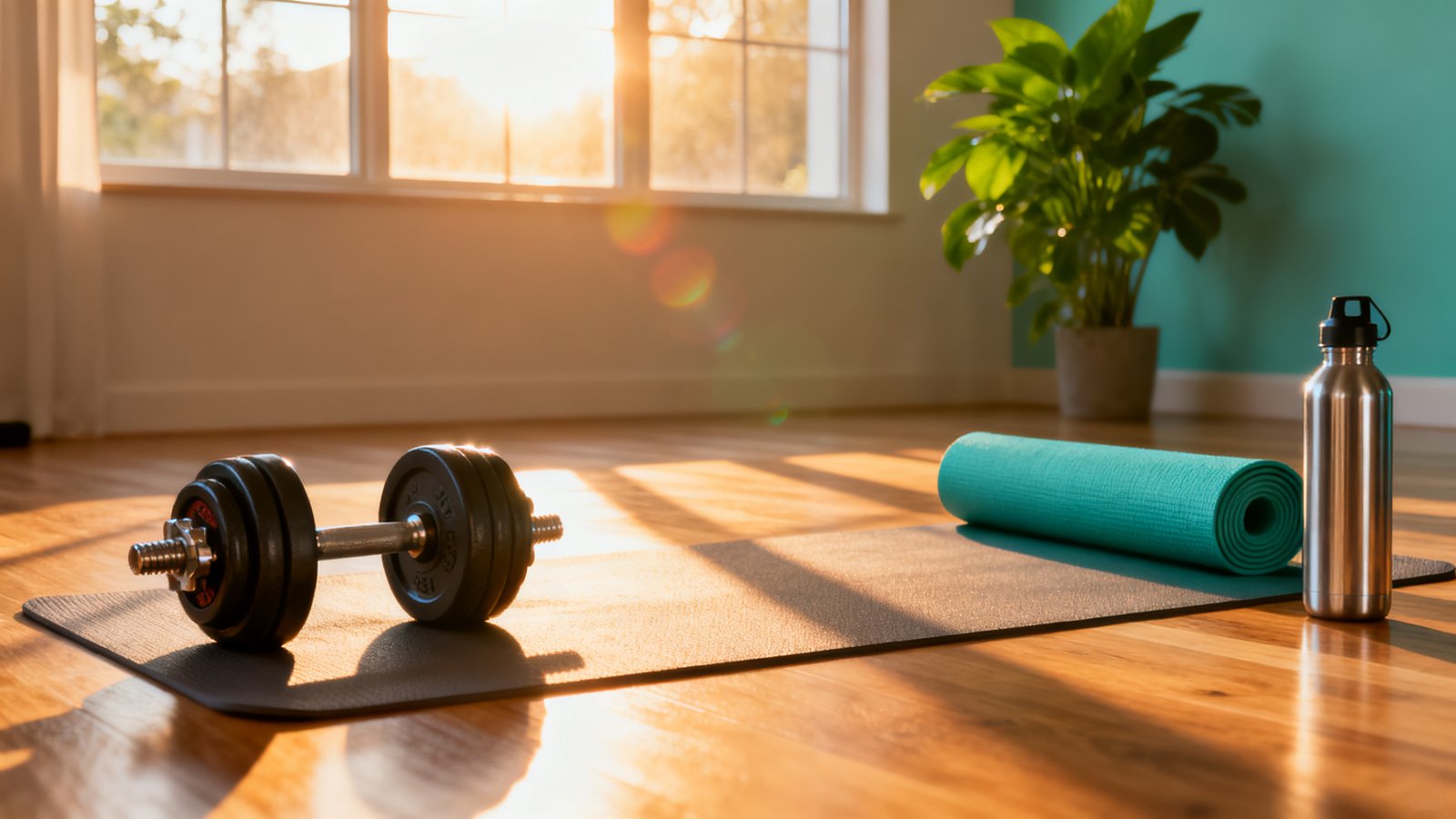
The whole setup needs three things: a pair of dumbbells, a non‑slip mat, and a few square feet of floor. That’s it. You don’t need a bench, a rack, or a dedicated room. A yoga mat or carpet works fine for floor presses and planks.
When you pick dumbbells, your budget and strength level matter. Below is what I recommend for different starting points.
| User | Suggested dumbbell | Weight range | Approximate cost |
|---|---|---|---|
| True beginner | Single fixed pair (e.g., CAP hex, 10‑20 lb) | 10‑25 lb per hand | $17‑$32 per pair |
| Beginner who wants to grow | Bowflex Results Series 1090 | 10‑90 lb | $799 |
| Budget adjustable option | REP QuickDraw or NordicTrack Select‑A‑Weight | 30‑55 lb | $335‑$400 |
| Experienced lifter | REP x PÉPIN Fast Series | up to 125 lb | $899‑$1,500 |
| Frugal home gym builder | Loadable Olympic handles plus plates | custom | $124.99 (handles only) |
If you already own a pair, start with what you have and upgrade when you can’t hit the rep targets anymore. Building a home gym under 500 is easier than most people think, and a single quality adjustable set often replaces an entire rack of fixed weights. Check our best adjustable dumbbells breakdown for more detailed picks.
Warm‑up (5 to 8 minutes): exactly what to do and why
A good warm‑up stops you from turning a 30‑minute workout into a two‑week layoff. Aim for 5 to 8 minutes of easy movement that primes hips, shoulders, and thoracic spine. You’ll also do two or three practice reps of the first exercise in the workout so your body knows what’s coming.
Here is the sequence I give every home lifter:
- Marching in place with high knees, 45‑60 seconds.
- Bodyweight hip hinges (slow, controlled), 8‑10 reps.
- Standing shoulder circles, forward and backward, 6‑8 each direction.
- Bodyweight squats, 8‑10 reps, focusing on depth.
- Practice reps of the main lift (goblet squat or RDL) with a very light load or no weight, 5‑6 slow reps.
This takes about five minutes. If you feel stiff, add a minute of easy thoracic rotations on the floor. Skipping this warm‑up is the most common mistake I see, and it leads to both injury and poor performance.
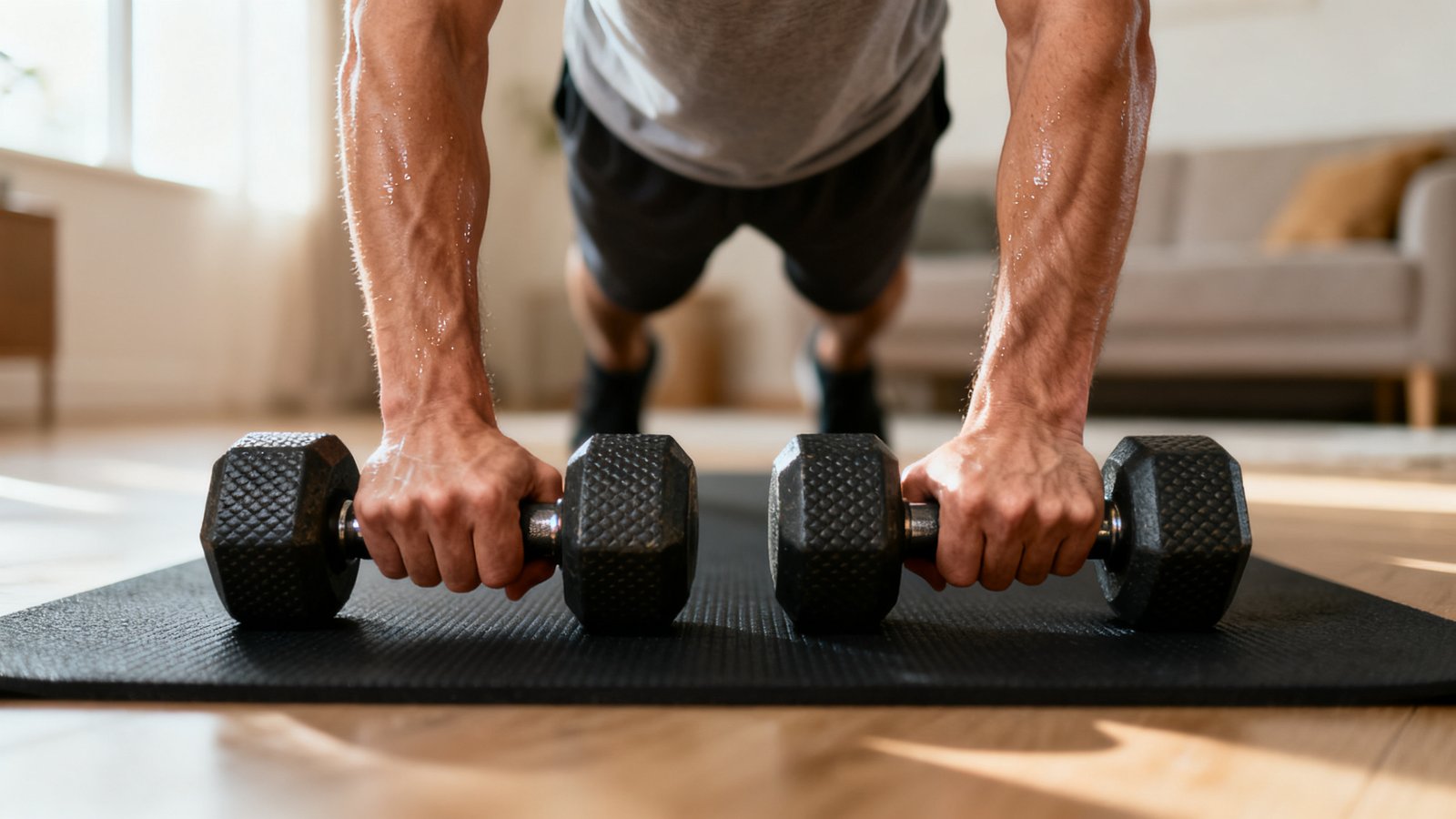
A 5 to 10‑minute warm‑up with dynamic stretches works well for most people and directly lowers the risk of muscle strains.
30‑minute no‑bench full‑body workout: Beginner template
This session uses a floor press instead of a bench, so you can do it anywhere. Perform each exercise with 60 to 90 seconds of rest between sets. If you need to fit everything into exactly 30 minutes, reduce rest to 45 seconds or drop one set of the last two exercises.
- A1. Dumbbell Romanian Deadlift – 3 sets of 8 to 12 reps
- A2. Goblet Squat – 3 sets of 10 to 15 reps
- B1. Dumbbell Floor Press – 3 sets of 8 to 12 reps
- B2. One‑Arm Dumbbell Row – 3 sets of 8 to 12 reps per side
- C1. Reverse Lunge or Split Squat – 3 sets of 10 to 12 reps per leg
- C2. Farmer Carry or Plank – 3 rounds of 30‑second carry or 45‑second plank
The rep ranges are standard for beginner strength plans. A floor press using 3×8‑12 builds pressing volume while protecting your shoulders. Many strength training at home beginners programs rely on this exact setup because it teaches tension without a spotter.
30 to 45‑minute no‑bench full‑body workout: Advanced template
If you can already handle moderate weights for high reps, this version pushes you harder with lower rep counts and more load. You still need no bench. The floor press stays, but you’ll shift to heavier, more explosive sets and add controlled tempos.
- A1. Dumbbell Romanian Deadlift – 4 sets of 5 to 8 reps (heavy, 3‑second lowering phase)
- A2. Goblet Squat or Zercher Dumbbell Squat – 4 sets of 6 to 8 reps
- B1. Floor Press with a 1‑second pause at the bottom – 4 sets of 5 to 8 reps
- B2. Single‑Arm Heavy Dumbbell Row – 3 sets of 6 to 10 reps per side
- C1. Loaded Carry (farmer or suitcase) – 3 rounds of 40‑60 seconds
- C2. Slow‑tempo Core Work (dead bug or hollow hold) – 3 sets of 8‑10 controlled reps
Rest 90 to 120 seconds on the main lifts. Use a weight that makes the last two reps of each set challenging but not sloppy. Advanced adjustable dumbbells like the REP x PÉPIN go up to 125 lb per hand, which covers most strength needs for home gym dumbbell training.
Progression plan: weekly microcycle and double progression
The program runs on double progression. Pick a rep range, start at the bottom, and add one rep each week while keeping form clean. When you hit the top of the range on all work sets, increase the weight by the smallest increment you have (usually 2.5 to 5 lb per dumbbell) and reset to the low end of the rep range.
For example, on goblet squats with an 8‑12 rep target:
- Week 1: 3 sets of 8 reps
- Week 2: 3 sets of 9 reps
- Week 3: 3 sets of 10 reps
- Week 4: 3 sets of 12 reps (then increase load and drop to 8 reps)
This method drives strength gains without guesswork. Commitment for at least four weeks before juggling exercises is key, otherwise you never build adaptation. A simple notebook or phone app tracks attendance, sets, reps, and load. If a lift stalls, add control‑based progression: slow the lowering phase to 3 seconds or add a brief pause at the bottom.
Recovery, soreness management, and the basics that matter
Recovery is where the strength actually builds. Sleep, hydration, and sensible intensity keep soreness manageable so you show up for the next session. Aim for 7 to 8 hours of sleep, drink water before, during, and after training, and don’t push every set to failure.
On off days, do easy walking or mobility work, not another hard workout. Every 4 to 8 weeks, schedule a deload: cut your sets in half or drop weights by 15‑20% for a week. This prevents burnout and keeps joints happy. If you’re so sore you can’t walk, you probably went too close to failure on too many sets. Beginners often do that because free plans leave out recovery guidance. This plan builds it in from day one.
Common mistakes in free plans and how this guide prevents them
Most free dumbbell routines online fail because they ignore the following pitfalls. Here is what goes wrong and how to fix each one immediately.
| Mistake | Consequence | Fix |
|---|---|---|
| Starting too heavy | Form breakdown, injury | Use a weight you can control for the bottom of the rep range first |
| Switching workouts every week | Zero progression | Stick to the same template for 4 weeks minimum |
| Skipping warm‑ups | Strains, poor performance | Do the 5‑move sequence every session |
| Training to failure on every set | Excessive soreness, inconsistent training | Leave 1‑2 reps in reserve on most sets |
| Not tracking anything | No clear progress | Log every set in a notes app or the printable sheet |
| Poor sleep and hydration | Stalled recovery | Prioritize bedtime and drink water regularly |
| Adding too many extra moves | Program creep, longer sessions | Stick to six exercises per session |
Adjustable dumbbells can also be a source of frustration if you don’t know their limits. Some bulky designs restrict range of motion in pressing, as noted in durability reviews, and dropping them may break the mechanism. Treat your equipment well and use floor presses to offset that awkward shape. Avoiding these mistakes is the fastest way to turn a scattered routine into a home gym mistake‑free plan.
If you don’t have a bench or heavy dumbbells: practical alternatives
No bench? The floor press is your best friend. It limits range of motion slightly but keeps tension on the chest and triceps and spares your shoulders. You can also do push‑ups or elevated push‑ups for additional volume. When dumbbells feel too light, use a loadable handle system (around $125 for handles) and add your own plates. That approach scales affordably. Fixed dumbbell pairs can cost as low as $1 per pound according to barbend.com data, so building a small collection over time is doable too.
If you’re maxed out on weight, modify the tempo. Slow negatives, pause reps, and higher rep sets (15‑20 reps) still drive hypertrophy. A 20‑lb pair can build muscle if you’re a true beginner, but you’ll need to increase load eventually. When that happens, an adjustable set that goes to 55‑90 lb is the next logical step, and you can often find them in the $335‑$800 range. Our home gym small space guide has more space‑saving ideas for tight setups.
Realistic timeline: when to expect strength and muscle changes
Strength improves before you see it. Within two to three weeks, you’ll likely notice that the same weight feels easier or that you can squeeze out an extra rep with good form. Visible muscle changes take longer, usually within the 8 to 12‑week window if you train consistently and eat enough protein. Don’t look for a mirror transformation at week three; trust the performance numbers. When your floor press goes from 8 reps to 12 with the same pair of dumbbells, you’ve built muscle even if the mirror lags. The printable microcycle below gives you a way to track those small wins that eventually add up.
Quick FAQ
What weights should I buy as a beginner vs advanced in 2026?
Beginners can start with a single fixed pair (10‑25 lb) or an adjustable set like Bowflex 1090 (10‑90 lb). Advanced lifters often need up to 125 lb per dumbbell, available in the REP x PÉPIN Fast Series. Your budget and strength goals dictate the choice, but adjustable dumbbells are the most space‑efficient route.
How long are the sessions?
The beginner template runs about 30 minutes when you manage rest tightly. The advanced template reaches 45 minutes. Always include the warm‑up. If time is short, cut one set from accessory work, not the main lifts.
What if I hit equipment limits?
Use tempo changes: 3‑second lowers, pauses, or extra reps. You can also move to single‑leg variations (split squats, single‑arm rows) to increase relative load without more weight. When you consistently outgrow your dumbbells, consider loadable handles or an expandable adjustable set.
How do I shorten the workout to a true 30 minutes?
Perform only three pairs of exercises: RDL + goblet squat, floor press + row, reverse lunge + plank. Reduce rest to 45 seconds and do 2 sets instead of 3 for the last couplet. This compresses the session without losing full‑body coverage.
Is a printable home dumbbell workout plan PDF available?
Yes. The next section describes the downloadable 4‑week starter microcycle with tracking sheets. It includes the warm‑up, three weekly templates, progression notes, and a deload reminder for week 5. Grab it to stay on track from day one.
Downloadable 4‑week starter microcycle
This microcycle gives you the exact foundation for the first four weeks. You’ll train on three non‑consecutive days, using a mix of beginner and intermediate rep schemes so you can scale up. The PDF includes daily warm‑up boxes, exercise tables with blank weight/reps slots, and a simple double‑progression chart. It also reminds you when to take a deload (week 5). I designed it to print on one page so you can stick it on the wall near your workout space.
Download the home dumbbell workout plan PDF now and start logging. Pair it with the checklist from our home gym essentials list to make sure you have everything you need.
Conclusion: a full body dumbbell workout home you can stick with
This plan removes the guesswork. You have a warm‑up that takes five minutes, a bench‑free beginner session that fits into 30 minutes, an advanced option for when the weights feel light, and a progression method that runs on simple math. No bench, no gym membership, no expensive machines. Commit to it for four weeks, track every rep, and don’t skip the warm‑up. The timeline for real change is 8 to 12 weeks, but you’ll feel stronger much sooner. When you need a full body dumbbell workout home that actually delivers, come back to this page, download the PDF, and adjust the load. You control the progression, and now you know exactly how.
Ready to start? Print the microcycle, clear a space on the floor, and hit your first session today.