

Key Takeaways
- Most buying guides omit the two measurements that determine whether a bench actually fits in your apartment: folded footprint depth from the wall and seat-to-floor height.
- Budget benches under $200 rarely fail catastrophically. What fails first is almost always the pad foam, vinyl upholstery, or the ladder pin mechanism, not the frame.
- No public data set in 2025-2026 tracks exact failure rates or deformation loads for consumer benches. Your best defense is a structured unboxing checklist and knowing which qualitative red flags actually predict early failure.
- Why this guide matters — the gap between specs and real life
- Quick decision checklist — buy or skip at a glance
- The small-space dimensions that make or break apartment use
- Durability realities — what actually fails first on budget benches
- Why you can’t trust headline ‘capacity’ numbers — and what to assume instead
- Construction comparison — what differs between sub-$200 incline/decline vs. $400 commercial benches
- Testing metrics buyers and reviewers should use (the missing benchmarks)
- Shipping damage and returns — what the public data does and doesn’t tell us
- How to evaluate product pages and reviews (practical red flags and trust signals)
- Buying scenarios and model selection framework
- Practical unboxing and first-30-day checklist (what to test ASAP)
- Final recommendations + content assets for the piece
Finding the best weight bench home gym buyers can actually trust is harder than it should be in 2026. You open a review, scan the specs, and see the same numbers recycled: 600-pound capacity, 14-gauge steel, folds flat. But none of that tells you whether the bench will wobble under your spine during a heavy dumbbell press or whether the vinyl will crack six months in. I wrote this guide because the gap between marketing specs and what happens in a 600-square-foot apartment is enormous, and nobody is measuring the things that actually predict whether you will regret your purchase.
If you live in a one or two bedroom apartment, you need a bench that stores vertically against a wall without tipping, clears your bed frame, and stays stable when you are pressing 50-pound dumbbells at 6 a.m. while your downstairs neighbor sleeps. You also probably want to spend under $200. That combination is achievable, but only if you know which specifications to ignore and which missing measurements to demand. This guide gives you the filtering framework, the testing protocol, and the red-flag checklist that existing buying guides do not provide.
Before we go further, a note on data honesty. There is no publicly available data set in 2025-2026 that answers precise failure rates or deformation loads for consumer benches. Market analyses and expert reviews provide qualitative trends, not numeric failure incidence. I will tell you exactly what is known, what is inferred, and what remains unknown so you can make a confident decision without pretending the data exists.
Why this guide matters — the gap between specs and real life
Most “best weight bench home gym” articles follow a predictable formula. They list five to ten benches, quote the manufacturer’s stated capacity, mention adjustability angles, and assign star ratings based on editorial impression. What they rarely provide are the apartment focused measurements and hard durability signals that determine whether a bench survives daily use in a small living space.
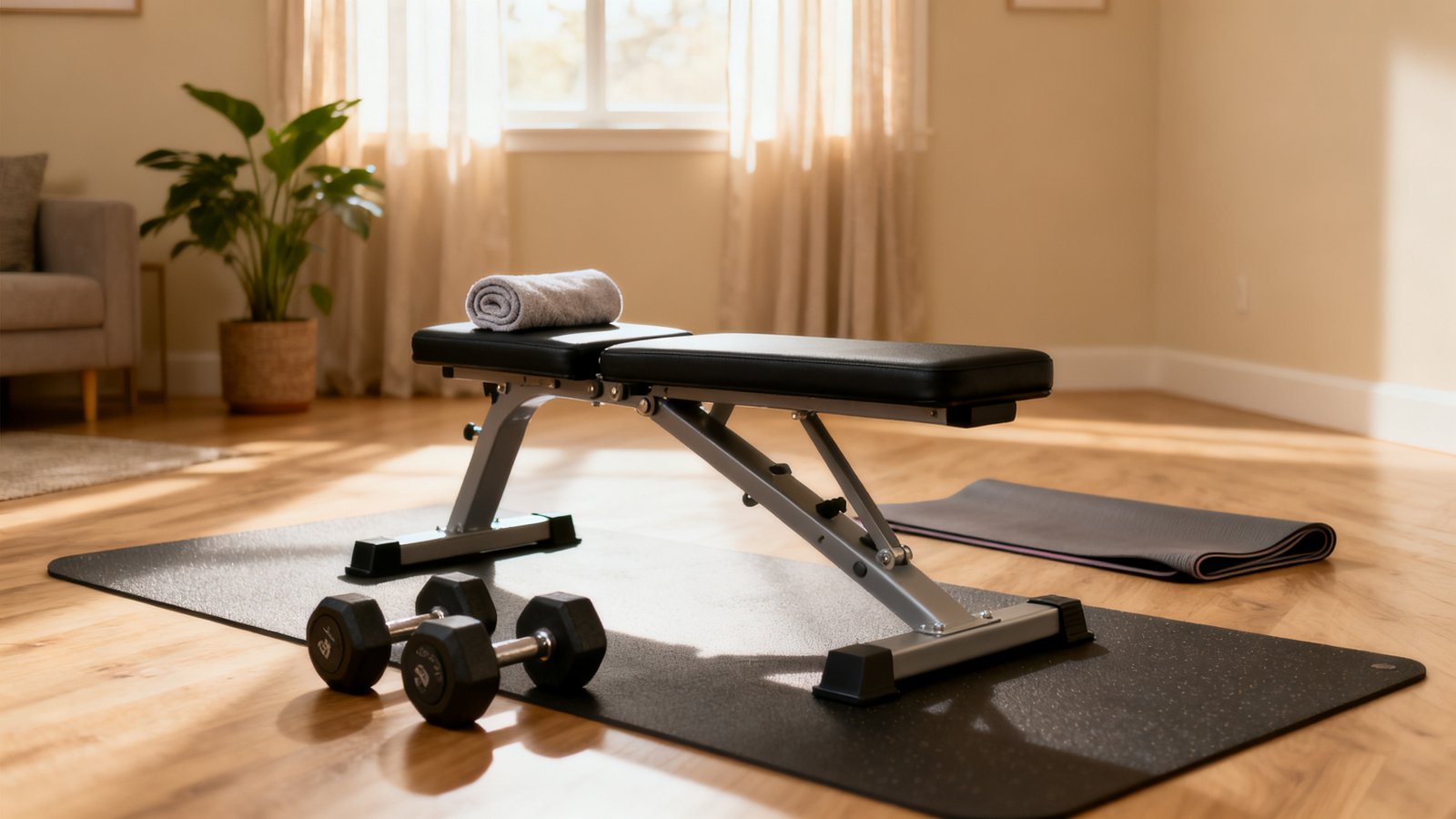
For example, a bench might claim a 600-pound capacity and fold for storage. But does it fold to 4 inches deep or 12? Does it stand under a standard 6-foot closet rod or does it need to lean against the wall? Does the seat sit at 16 inches from the floor, which works for most lifters, or 19 inches, which can throw off your leg drive and feel unstable? These are the questions that matter when your gym is also your living room.
Existing sources, including large guides that test over 50 benches, synthesize durability feedback from user reviews and hands-on testing, but express it in editorial language like “wobble,” “cheap hardware,” or “pad wears quickly” rather than numeric failure incidence. Major buying guides emphasize capacity, adjustability, and pad quality while mentioning folded dimensions inconsistently. That inconsistency is exactly what this guide aims to fix.
If you have already been burned by common home gym mistakes like buying equipment that does not fit your space, you know the frustration of relying on incomplete spec sheets.
Quick decision checklist — buy or skip at a glance
Before you even compare models, run any weight bench for home use through this filter. If a bench fails two or more of these checks, move on.
Must-haves for an adjustable weight bench under 200:
- Folded footprint depth (from wall) is listed and under 14 inches. If the brand does not publish this, assume it is too deep for apartment storage.
- Seat-to-floor height in the flat position is listed. If it is missing, you cannot verify whether your feet will plant flat on the floor, which matters for stability on every pressing movement.
- The product page shows close-up photos of the welds and the ladder pin or pop-pin mechanism. If these are hidden or blurry, treat it as a red flag.
- Return policy includes prepaid return shipping or at minimum a clear window with no restocking fee. Benches are heavy and expensive to ship back.
Dealbreakers:
- Single capacity number with no clarification on whether it includes user bodyweight plus load. If the page is ambiguous, the bench probably wobbles under real loads.
- No photos of the bench in its folded position. If they will not show it stored, it probably does not store well.
- Vinyl that looks shiny and thin in product photos. Quality upholstery has a matte, textured finish and visible stitching reinforcement at the front edge of the seat.
Guides frequently omit folded footprint and seat-to-floor height, yet these measurements are critical for small apartments. If you are also piecing together a home gym under 500 dollars, space efficient choices compound quickly.
The small-space dimensions that make or break apartment use
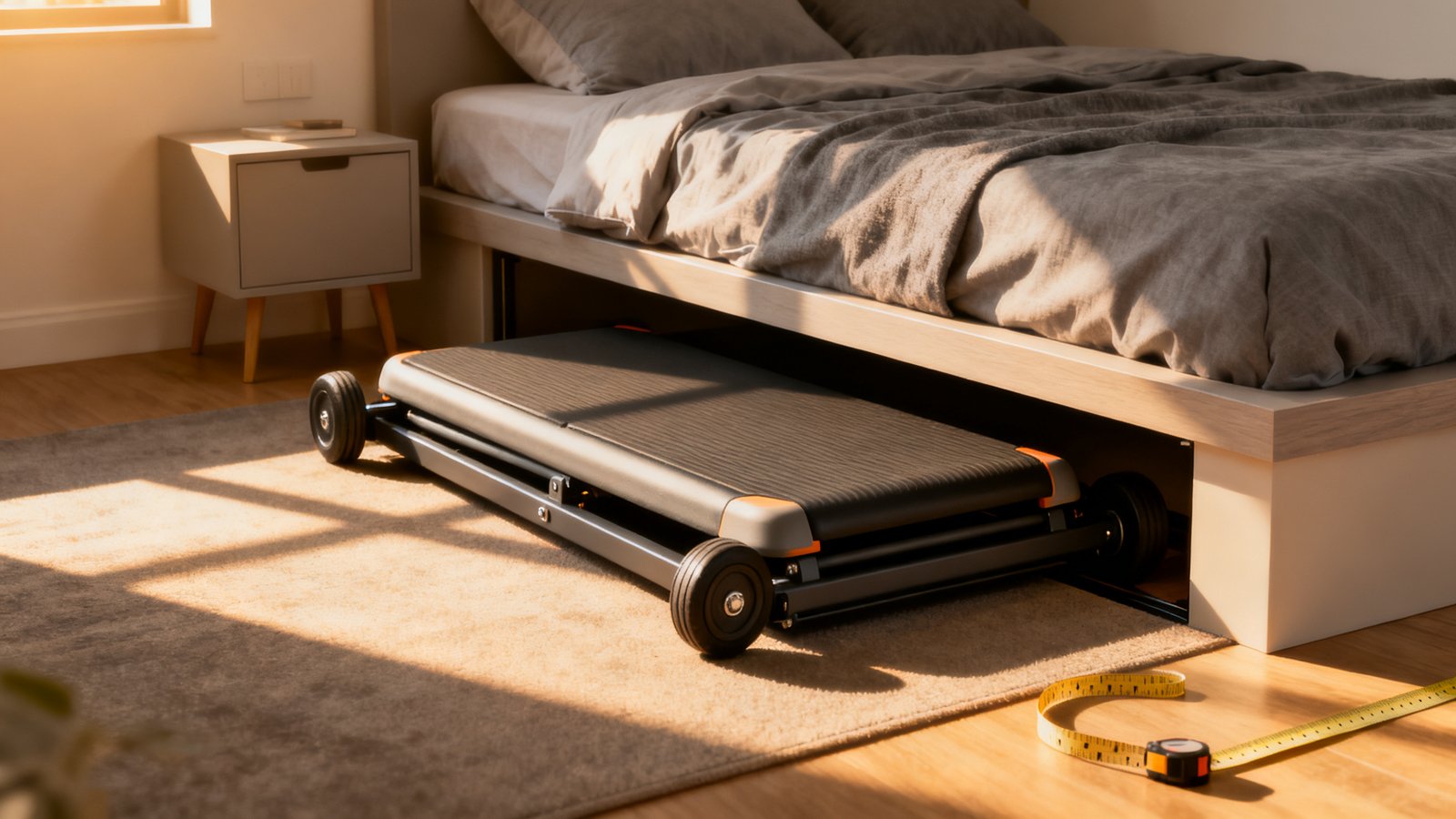
Most top buying guides inconsistently report folded dimensions and rarely list seat-to-floor height, even though these drive whether a bench fits in a closet, clears doorways, or slides under a bed. If you are shopping for a foldable weight bench apartment dwellers can actually live with, here are the hidden dimensions you need to measure before buying, or at minimum verify from a review photo.
Folded footprint depth from wall. This is the distance the bench protrudes when stored upright against a wall. A bench that folds flat but still sticks out 16 inches is a tripping hazard in a narrow hallway. Target: under 10 inches for high-traffic areas, under 14 for dedicated corners.
Folded height. If you plan to store the bench in a closet, it needs to stand under the hanging rod, typically around 68 to 72 inches. Some benches fold to 74 inches and simply will not fit. Measure your clearance first.
Seat-to-floor height in flat and incline positions. This determines whether your feet plant securely. At 5-foot-8 with a 16-inch seat height, most lifters are fine. At 19 inches, shorter users lose ground contact, which destabilizes the entire setup. Very few guides list this number, yet it is one of the strongest predictors of perceived stability.
Overall length flat. Taller lifters over 6 feet need a bench long enough to support head and hips simultaneously. Look for at least 50 inches of pad length. Many budget benches come in closer to 46 inches, which leaves your head hanging off during pullovers or presses.
Footprint width including protruding feet. Rear feet that flare out wide improve stability but consume floor space and create trip risks. Measure the space between your bed and wall or couch and TV stand. If the bench feet extend beyond your planned workout area, you will be constantly shuffling furniture, which kills workout consistency. For more on compact setups, see our guide to building a home gym in a small space.
Durability realities — what actually fails first on budget benches
Typical weak points on any adjustable weight bench under 200 follow a predictable pattern. Across expert testing and review aggregation, three failure modes dominate.
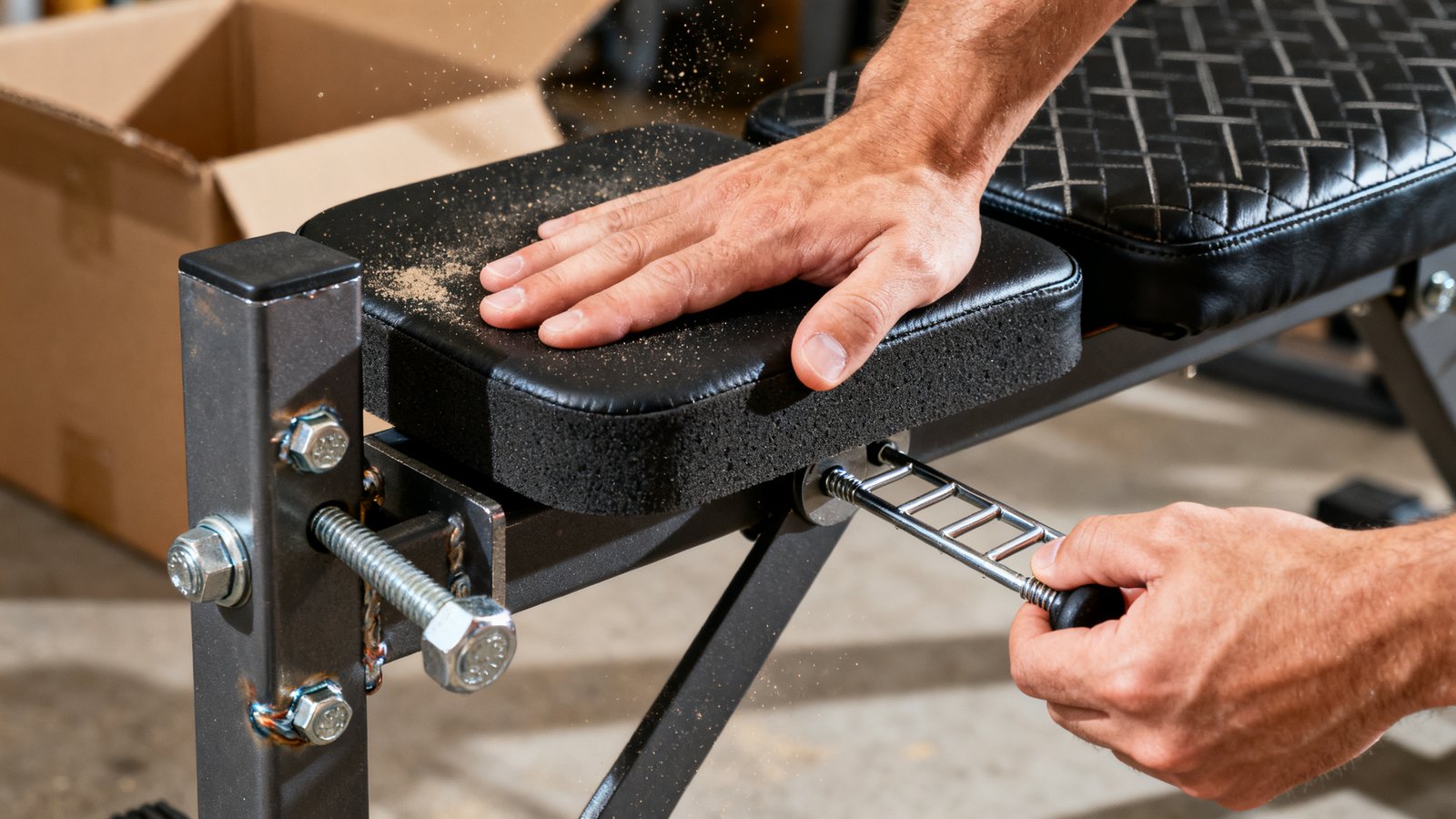
Foam compression and vinyl tearing. This is the first thing to go. Budget benches use lower-density foam and thinner vinyl. Within six to twelve months, the foam compresses permanently where your hips and shoulders contact the pad. The vinyl stretches, develops micro-tears at the stitched seams, and eventually splits at the front edge of the seat. You can spot this risk before buying: look for pads thinner than 2.5 inches and vinyl with a shiny, plastic-like sheen rather than a textured matte finish.
Ladder pins and pop pins. On cheaper ladder-style or pin benches, the adjustment hardware wears quickly. Pins become loose in their channels, develop play, and eventually fail to seat fully. Under load, a partially seated pin can slip, dropping the back pad unexpectedly. This is not a catastrophic failure, but it is dangerous on a heavy set. Inspect pin engagement depth in product photos. A pin that only engages by a quarter-inch is a future problem.
Hinges and welds. Less common but more serious. Under heavy or abusive loads, hinge points and welds at the junction of the back pad frame and the main upright can crack. User photos in one-star reviews occasionally show this, though there are no statistically aggregated failure frequencies. Expert video reviews note that budget tripod-frame designs under about $160 see wobble complaints spike, attributing this to lateral rigidity being dependent on frame mass.
Why you can’t trust headline ‘capacity’ numbers — and what to assume instead
Expert guides note many brands list a single “weight capacity” without clarifying whether it includes user bodyweight plus load or whether it applies to all positions. Some brands are praised for clearly separating bench rating versus user plus weight rating, but most do not. This inconsistency contributes to buyer confusion and, anecdotally, purchase abandonment, though no quantitative funnel data for “budget workout bench 2026” searches is publicly available.
Here is what happens in practice. A bench rated for 600 pounds might mean 600 pounds of external load excluding the user, or it might mean 600 pounds total including a 200-pound user and 400 pounds of barbell and plates. On an incline setting, the same bench might realistically support only 400 pounds because the load path shifts and the adjustment mechanism bears more stress. One expert reviewer documented a bench rated for 600 pounds when inclined and 1000 pounds when flat, demonstrating that capacity depends on position and load path.
Practical rule of thumb: If the capacity number is a single figure and the brand does not explicitly state “includes user weight” or “flat only,” assume the real-world safe working load is roughly two-thirds of the stated number when flat, and half when inclined. A 600-pound rated bench becomes a 400-pound flat bench and a 300-pound incline bench in practice. For most home users under 200 pounds lifting moderate weight, that is still adequate. But if you weigh 220 and plan to bench 275, you are already approaching that derated limit on a budget bench.
Buying guides for home users often suggest that a 600 to 1000 pound capacity is desirable, even for people who will never approach those loads, because it implies better overall build quality and stability. Several expert testers implicitly treat about 600 pounds total capacity as a floor for general-purpose home benches. For context on how weight selection affects your overall setup, see our guide on how much weight you need for a home gym.
Construction comparison — what differs between sub-$200 incline/decline vs. $400 commercial benches
Budget benches commonly use thinner tubing, around 14-gauge for the main frame, sometimes 12-gauge on slightly better units. Higher-end benches around $400 often use 11 or 12-gauge steel in larger tubing like 2×3 inches or 3×3 inches and weigh substantially more, which directly improves rigidity. Garage Gym Reviews notes that commercial-style benches use more continuous welds at critical points and fewer bolted joints in the main load path.
Tubing dimensions and wall thickness are not consistently disclosed by budget manufacturers. Reviewers often infer frame quality from total bench weight. A bench weighing under 40 pounds is almost certainly using lighter-gauge steel and bolt-together construction. A bench weighing 60 to 80 pounds is typically using thicker steel with more welded joints. Weight alone is not a perfect proxy, but in the absence of published gauge data, it is one of the few publicly available signals.
| Feature | Sub-$200 Budget Bench | $400+ Commercial Bench |
|---|---|---|
| Steel Gauge | 14-gauge typical, some 12-gauge | 11-12 gauge common |
| Tubing Size | 2×2 inches or smaller | 2×3 or 3×3 inches |
| Joint Type | Mostly bolt-together | More continuous welds |
| Total Weight | 35-55 lbs | 65-100+ lbs |
| Pad Thickness | 2-2.5 inches, lower density | 2.5-3+ inches, higher density |
| Capacity Transparency | Often vague or single number | Typically flat vs. incline specified |
No published lab test documents “bench X deforms at Y pounds” for a sub-$200 bench versus a $400 commercial model. No standardized deformation protocol with specified safety factors is publicly tied to specific consumer benches. The table above reflects qualitative patterns from expert reviews, not measured deformation thresholds.
Testing metrics buyers and reviewers should use (the missing benchmarks)
Top guides omit numerical stability metrics. The best folding weight bench for small space use would ideally be evaluated with standardized measurements that currently do not exist in published reviews. Here are the benchmarks that would fill the gap, and that you can approximate at home.
Lateral wobble under load. Load the bench with your bodyweight plus your working dumbbell weight. Have someone measure side-to-side displacement at the shoulder end of the pad in inches. A budget bench might show 0.5 to 1 inch of lateral movement. A commercial bench might show 0.25 inches or less. You can approximate this by loading the bench and pressing with one arm while filming from above.
Fore-aft rocking. With the bench loaded, shift your weight forward and backward. Measure vertical displacement of the front or rear foot. If either foot lifts off the floor by more than a quarter inch during normal movement, the bench is underbuilt for your weight and lift style.
Tip-resistance threshold. Apply an off-center load, such as sitting on one edge of the pad with feet off the floor. Note at what percentage of your bodyweight the bench begins to tip. This matters if you ever do single-arm dumbbell work or shift position mid-set.
Folded volume versus mass. Multiply folded length, width, and depth to get cubic inches, then divide by bench weight in pounds. A lower number means more mass packed into less storage volume, which generally correlates with better stability for the same footprint. This metric does not exist in any current guide but is simple to calculate.
If you are also considering space-saving adjustable dumbbells for your apartment, applying similar dimensional scrutiny to both purchases ensures your entire setup fits.
Shipping damage and returns — what the public data does and doesn’t tell us
There are no publicly available 2025 statistics for shipping damage rates or return costs specifically for adjustable weight benches. No platform-level damage rate broken out by Amazon, Walmart, or direct brand sites exists in published sources. What we have are anecdotal signals from user reviews and policy-level information.
User reviews on large marketplaces regularly mention shipping damage including scratched paint, bent frame components, and missing hardware. Some reviewers highlight better packaging or customer service from certain brands, but no platform-level rates or cost data are provided. Market analyses for FID benches discuss margins, prices, and features but do not publish logistics KPIs such as damage frequency or average reverse logistics cost per bench returned.
How to minimize your risk on any adjustable weight bench under 200: Choose sellers that clearly state their return window and whether return shipping is prepaid. Read the one and two-star reviews sorted by most recent. Look for photo evidence of box condition upon arrival. If multiple recent reviews show similar damage patterns like bent rear feet or crushed corners, that packaging is systematically failing regardless of carrier.
For additional cost context, our home gym versus gym membership cost comparison factors in the hidden expense of returns and replacements that first-time buyers rarely budget for.
How to evaluate product pages and reviews (practical red flags and trust signals)
Some brands are praised for clearly separating bench rating versus user plus weight rating. Many do not. This inconsistency contributes to buyer confusion and is one of the strongest signals of whether a brand is being honest or relying on optimistic marketing.
Trust signals to look for: explicit flat versus incline capacity listed separately, full folded dimensions including depth from wall and height, seat-to-floor height in flat and incline positions, close-up photos of welds at the main frame joints, multi-angle photos of the box and packaging foam, verified-review photos showing the bench after months of use, a clear returns policy with no restocking fee language, and manufacturer contact information that is easy to find.
Red flags: a single capacity number with no clarification, one photo of the bench from a single angle, no folded-position images, generic product descriptions that could apply to any bench, reviews that all cluster around the same date suggesting a promotional push, and no response from the seller to negative reviews. These patterns consistently correlate with benches that underdeliver on durability and fit.
Buying scenarios and model selection framework
No source publishes one-year durability ratings for under-$200 models. Instead, use qualitative signals like user reports, pad condition in long-term review photos, pin type, and frame weight to judge likely longevity. Here is a framework for three common personas.
Scenario A: Small-apartment casual lifter. You lift three to four times per week with dumbbells up to 50 pounds each. Your priority is storage. Target a foldable weight bench apartment storage spec of under 10 inches folded depth and under 70 inches folded height. Seat height under 17 inches. Accept that you are trading some stability for storability. Pad durability matters less because your loads are moderate. Prioritize folded dimensions and return policy over capacity claims.
Scenario B: Budget strength trainee under $200. You barbell bench, row, and do seated overhead presses. Your combined user-plus-barbell weight might approach 400 pounds. Prioritize pin quality and pad durability. Look for benches with thick ladder pins that engage deeply, not thin pop-pins with spring mechanisms that can fail. Check that the pad is at least 2.5 inches thick with dense foam. Reject any bench that does not show close-up photos of the adjustment mechanism. A complete home gym essentials list will help you allocate budget across all your equipment, not just the bench.
Scenario C: Serious lifter wanting a durable home bench. You deadlift, heavy bench, and use the bench for rows and split squats. You should probably spend $400 or more. Look for disclosed 11-gauge steel, continuous welds at the back pad to upright junction, three-post or ladder-style adjustment with thick pins, and a bench weight over 65 pounds. The higher price buys measurable improvements in gauge, weld quality, and pad density, even though exact deformation thresholds remain unpublished.
Practical unboxing and first-30-day checklist (what to test ASAP)
User reviews routinely cite shipping damage including scratches, bent frames, and missing parts. Early hardware wear is also commonly reported. Reviewers consistently recommend inspecting hardware, welds, and pads immediately upon arrival. Here is your step-by-step protocol for any weight bench for home use.
Day one, before assembly: Photograph the box from all sides before opening. Open and photograph all foam and plastic packaging. Inspect every weld joint under bright light. Look for cracks, incomplete penetration, or rust at the weld. Check that all bolts, nuts, washers, and pins are present and match the parts list. If anything is missing, photograph the empty packaging and contact support immediately.
After assembly: Measure the seat-to-floor height in flat position and compare it to the listed spec. Measure the folded footprint depth from the wall. If either measurement is off by more than an inch, the listing was inaccurate and you have grounds for a return. Press your thumb into the pad center. If compression exceeds half an inch, document it with a photo next to a ruler.
Within 30 days: Perform a 150 to 200 pound stability test by loading the bench with your bodyweight plus dumbbells or sandbags to simulate your heaviest working set. Check for lateral wobble and fore-aft rocking as described in the testing metrics section. Listen for creaking at the hinge points. If the bench passes, it will likely serve you well. If it wobbles visibly on video under a load within the stated capacity, initiate a return within the policy window. Time-stamp everything.
Final recommendations + content assets for the piece
Guides routinely fail to report key dimensions and numerical stability metrics. The best weight bench home gym buyers can confidently purchase is the one where you independently verified the folded depth, seat height, and stability under your actual working load before the return window closes. That is not a brand recommendation. It is a process recommendation, and it matters more than any editorial star rating.
Top three purchase criteria for small-apartment buyers, ranked: First, verified folded footprint depth from wall under 14 inches, ideally under 10. Second, seat-to-floor height listed and verified at 17 inches or below in flat position. Third, clear return policy with prepaid shipping or no restocking fee. Capacity numbers, brand reputation, and adjustability range are all secondary to these three factors because if the bench does not fit in your apartment or your feet do not reach the floor, nothing else matters.
Printable testing protocol (sidebar or checklist): Measure folded depth and height before accepting the delivery. Inspect all welds under light, photographing any cracks or rust. Press-test pad foam and measure compression. Load-test at 150 to 200 pounds above bodyweight and film lateral wobble. Document everything with timestamps. Return immediately if any test fails within the policy window.
Template email for returns and claims: “I received [bench model] on [date]. Upon inspection, I found [specific defect with photo attached]. The [measurement] differs from the listed specification by [amount]. I am requesting a prepaid return label and full refund under your [number]-day return policy. Please confirm the return authorization within 48 hours.” Keep it factual, reference the policy, and attach photos. This approach resolves claims faster than emotional complaints.
When you prioritize clearly reported folded dimensions and seat height, and prefer benches that disclose tubing gauge or show robust welds in photos, you bypass the marketing noise that traps most first-time buyers. The best weight bench home gym for your apartment is the one that survives your unboxing checklist and fits your actual measured space, not the one with the highest Amazon rating based on reviews written three days after delivery.
Frequently Asked Questions
What is the most important measurement for an apartment weight bench?
Folded footprint depth from the wall. If the bench sticks out more than 14 inches when stored upright, it becomes a tripping hazard in narrow hallways and small rooms. Seat-to-floor height is a close second because it determines whether your feet plant securely during lifts. Most buying guides omit both measurements.
Can I get a durable adjustable bench for under $200?
Yes, but you trade pad density, steel gauge, and long-term upholstery durability. The frame itself rarely fails catastrophically. What fails first is the foam compressing, the vinyl tearing at the seams, or the adjustment pin developing play. Prioritize models with thick ladder pins and pads over 2.5 inches, and inspect both immediately upon unboxing.
Why do budget benches wobble more than expensive ones?
Budget benches typically use thinner 14-gauge steel, smaller tubing dimensions, and more bolt-together joints instead of continuous welds. They also weigh less, which means less mass to dampen lateral movement. The wobble is not a safety failure in most cases, but it is distracting and reduces confidence under heavy loads.
Does a 600-pound capacity rating mean the bench holds 600 pounds safely?
Not necessarily. Many brands do not clarify whether the rating includes user bodyweight plus external load or only the external load. Some benches are rated for 600 pounds flat but only 400 pounds at incline. If the listing is ambiguous, assume the real safe working load is about two-thirds of the stated number when flat and half when inclined.
What should I check immediately after unboxing a new bench?
Photograph the box and packaging before opening. Inspect every weld for cracks or rust. Verify all hardware is present. Measure seat-to-floor height and folded depth against the listed specs. Press-test the pad foam. Load-test at your working weight and film for wobble. If anything fails or measurements are off by more than an inch, initiate a return within the policy window.