

The best pull up bar home setup isn’t the one with the most features. It’s the one that fits your space, feels solid under load, and gets used every single day.
You can spend $30 on a no-screw telescopic bar that dents your doorframe after two weeks. Or you can overpay for a free-standing rig that wobbles with every rep. The sweet spot lies in matching the bar type to your living situation, your budget, and your willingness to drill holes in your walls. This guide cuts through the marketing claims and gives you the raw tradeoffs so you pick right the first time.
Key Takeaways
- Renters and anyone avoiding damage should start with a premium no-screw doorway bar, but only if they accept the inherent stability limits for strict pull-ups.
- Serious trainees using weighted pull-ups or kipping need a wall-mounted bar bolted into structural studs; there is no safe shortcut here.
- Free-standing stations solve the drilling problem for garage gyms but often require bolting anyway once you test them, and they claim significantly more floor space.
- Quick Buying Summary — Which type to pick in one sentence
- Side‑by‑side comparison: Doorway vs Wall‑Mounted vs Free‑Standing
- Safety, Stability, and Injury Considerations
- Ceiling Height, Clearance and Weight Limits
- Installation: time, tools, costs
- Durability & Maintenance
- Price Range & Warranty Comparison — 2026 best models
- Top Negative Reviews & How to Avoid These Issues
- Recommended Picks by Use Case
- Buying Checklist & Pre‑Purchase Questions
Quick Buying Summary — Which type to pick in one sentence
Here is the fastest recommendation matrix you will find for a best pull up bar home purchase. Choose a doorway pull up bar if you need a no-drill solution for a tight apartment and accept that you cannot kip or swing. Choose a wall-mounted bar if you own your space, want maximum stability for heavy weighted pull-ups, and can spend an hour finding studs. Choose a free-standing station only if you have a dedicated garage gym, need multiple stations, and can bolt it down.
The research from GarageGymReviews backs up the qualitative split here. Wall-mounted bars are consistently more stable across products tested. Doorway bars save space but introduce risk if pushed beyond their limits. Free-standing units sit in a gray area where some models remain shaky unless bolted down.
This one paragraph likely just saved you from three hours of scrolling Amazon reviews. The rest of this guide gives you the precise measurements, installation steps, and model comparisons so you execute on this recommendation without surprises.
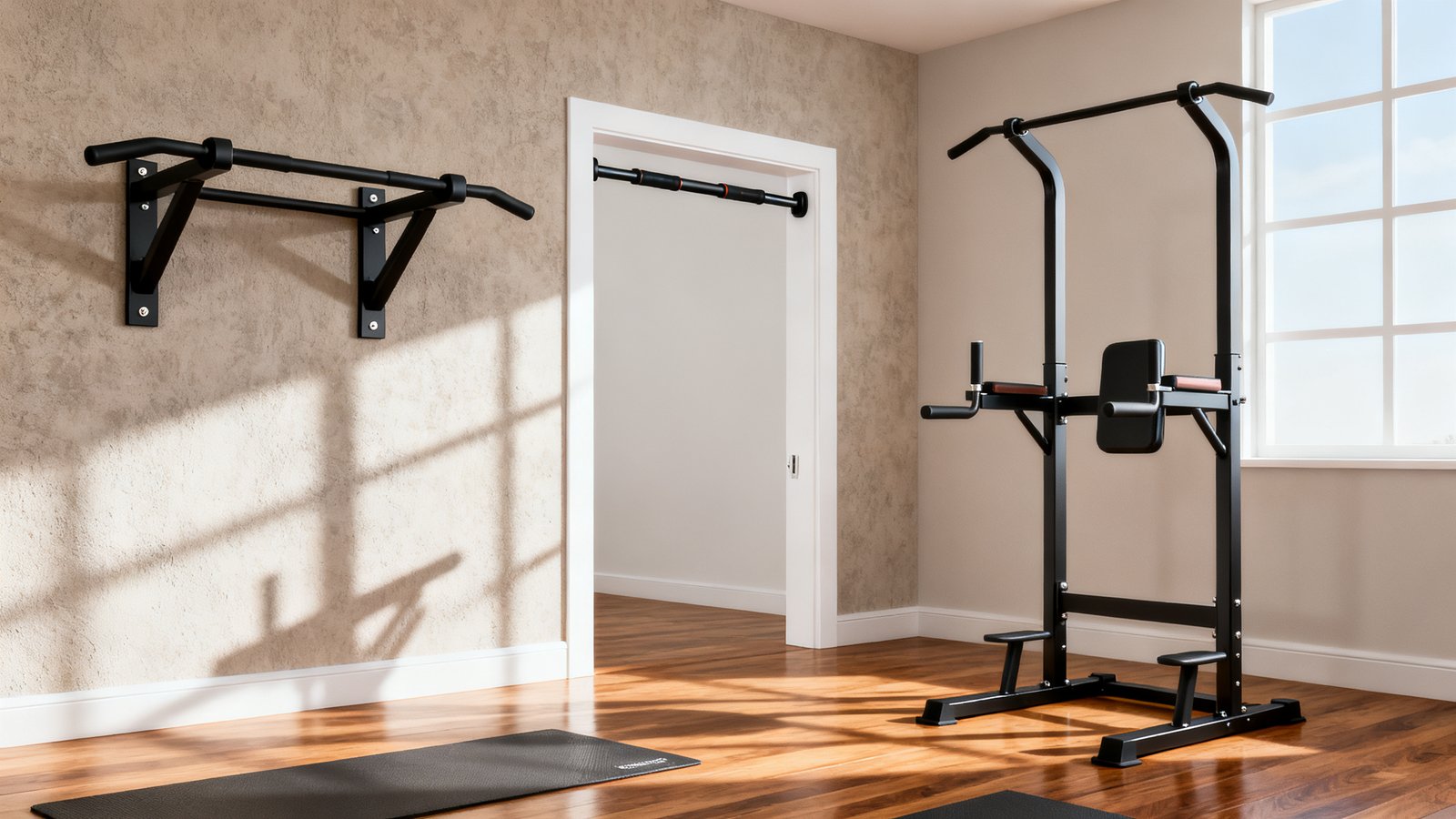
Side‑by‑side comparison: Doorway vs Wall‑Mounted vs Free‑Standing
Most buyers fixate on price first. That is a mistake. You need to rank stability, permanence, available space, and the specific exercises you will actually practice. A $30 doorway bar that you outgrow in two months is more expensive than a $140 wall unit you use for years.
Doorway pull up bar options split into two camps: telescopic tension rods and hook-over-frame designs. Both claim no drilling. Both rely on leverage and friction. They work for strict pull-ups and chin-ups but fail the moment you introduce momentum. If you weigh 200 pounds and want to do controlled reps, a well-rated tension bar holds. If you plan to kip or attempt muscle-ups, the bar can dislocate. The upside is instant portability and zero wall damage when installed correctly. The downside is almost every single product page includes at least one photo from a buyer showing cracked door trim.
A wall mounted pull up bar directly addresses the stability problem. Bolting into studs gives you a connection that handles 500 to 700 pounds of dynamic load. You can kip, you can hang rings, and you can add weight without the setup flexing. The tradeoff is permanent modification of your space. Renters often lose their deposit if they install one without landlord approval. For a more detailed breakdown on setting up a full gym in limited space without breaking your lease, check home gym small space setups. The installation process also demands a stud finder, a drill, and accurate measurement. One mistake and you have ugly holes in drywall that need patching later.
Free-standing pull-up stations occupy the middle ground that often pleases no one. They do not require wall mounting. They give you extra stations for dips or knee raises. But they have a large footprint. The Fringe Sport Garage Series Squat Rack, for example, can show instability during pull-ups unless you bolt it to the floor or weigh it down. A standalone unit that still needs bolting defeats half its purpose. For a wider look at how to prioritize equipment for home gym under 500 dollars, free-standing stations often consume a disproportionate slice of the budget while offering less stability than a dedicated wall bar.
Safety, Stability, and Injury Considerations
No formal injury data exists in the research from GarageGymReviews for pull-up bar failures. But ignoring the qualitative stability notes would be foolish. The best pull up bar home setup is one that never sends you to the floor mid-rep.
Doorway bars present the clearest safety concern. The bar is held in place by outward force on the trim or by a small lip hooked over the molding. If you swing forward or pull unevenly, the bar can slip. The safest doorway setups include an additional strap reinforcement or a design that hooks widely over the frame to distribute force. Even then, keep your reps slow and centered.
Wall-mounted bars are generally more stable. The Titan wall-mounted bar, for instance, showed no shakiness during kipping and muscle-ups in tests. Stability depends entirely on whether you hit the center of two studs and use the correct lag bolts. If you mount into drywall anchors alone, you are creating a serious hazard. The load margin matters. If you weigh 180 pounds and add a 45-pound plate for weighted pull-ups, you need a bar rated far above 225 pounds because dynamic force multiplies the effective load. Aim for a bar rated at least double your loaded bodyweight.
A free standing pull up station follows different physics. The base must be wider than the pull-up area to prevent tipping. Many budget stations have a narrow footprint and feel tippy. The advice from GarageGymReviews is blunt: if the station wobbles, bolt it. For renters, this kills the argument for free-standing over wall-mounted.
For more context on avoiding expensive errors, see the guide on home gym mistakes where common stability and attachment failures are broken down further.
Ceiling Height, Clearance and Weight Limits
The product pages and review sites rarely give you a simple clearance formula. So here is one. Measure your doorframe height. A doorframe chin up bar that hooks over the top will add a few inches of hang depth. You need at least six to eight inches of clearance from the top of your head to the underside of the bar to avoid banging your skull during kipping. If your ceiling is 8 feet and the top of the bar sits at 7 feet, you have roughly 12 inches to work with. That works for strict reps but not for chest-to-bar movements.
Wall-mounted bars give you full flexibility. You choose the height during installation. The REP multi-grip bar shows a smart design trick: you can invert it to fit lower ceilings. That is useful for basement gyms with 7 foot clearances. Weight limits on wall bars are generous. REP lists a 700 pound capacity. Titan rates its wall bar at 500 pounds. BaseBlocks, a free-standing model, holds 660 pounds. Those numbers all exceed what most users will ever need, even with heavy weighted vests.
If you are building out a basement with low clearance and need other compact options, home gym essentials list covers additional space-saving gear that pairs well with a low-hung pull-up bar.
Free-standing stations demand the most vertical clearance. You need headroom plus the bar thickness plus space for the frame itself. Many models top out above 7 feet tall. Before ordering a best pull up bar for home gym 2026 model in the free-standing category, confirm both the assembled height and the recommended clearance zone above the bar, which manufacturers rarely publish. Call them if it is not listed.
Installation: time, tools, costs
A pull up bar no screws purchase feels satisfyingly quick. You open the box, twist or hook it into place, and start training in under two minutes. BaseBlocks claims a 15 minute assembly for its free-standing The Big Bar model. Realistically, budget 30 minutes to read the manual and tighten all bolts. Doorway tension bars take seconds but require periodic re-tightening as the pads compress.
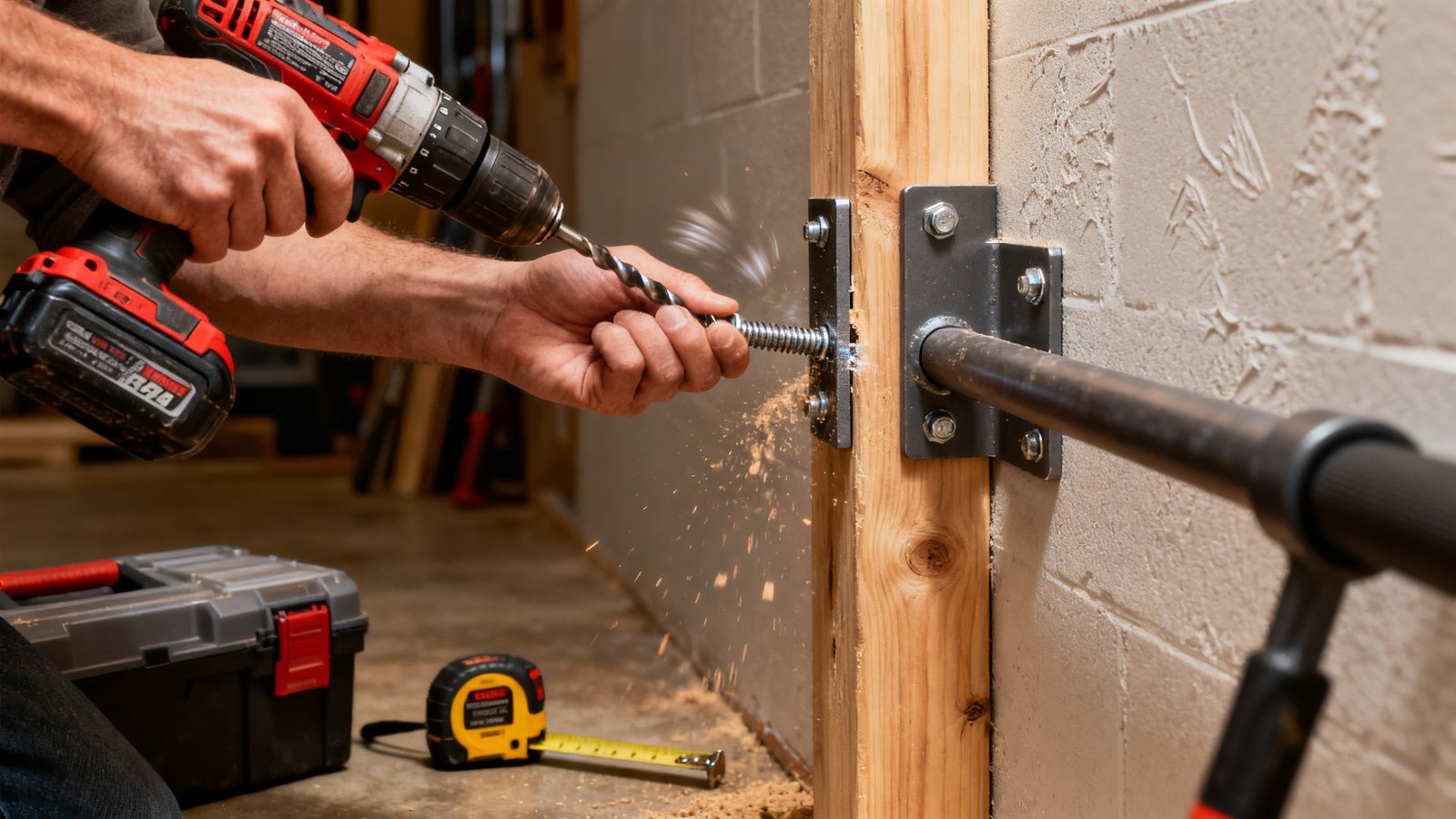
Wall-mounted bars sit on the opposite end. You need a stud finder, a drill with the correct bit size, a level, and optionally a socket wrench for lag bolts. The process: locate the center of two studs 16 inches apart, mark the hole positions with the bracket as a template, drill pilot holes, and bolt the bracket down. If your stud spacing does not match the bar’s predrilled holes, you have to mount a stringer board across the studs first, then attach the bar to that board. This can double your install time. The Titan wall bar and REP bar both require drilling. The GarageGymReviews notes on Titan even mention that you might need a trip to the hardware store for optimal mounting hardware. Factor in $10 to $20 for high-grade lag bolts if the included ones look weak.
Professional mounting by a handyman should cost $50 to $100 in most markets. If you have never located a stud and do not own a drill, that $50 is insurance against torn drywall and a surprise fall.
For more cost-driven decisions, home gym vs gym membership cost compares the long-term investment of permanent equipment versus recurring fees, which is useful context when weighing the price of solid installation.
Durability & Maintenance
The wear points differ dramatically by type. A wall mounted pull up bar has almost no moving parts besides the grip sleeves. Check the bolt tightness every month. Knurling can wear smooth after years of heavy use, but that takes a decade in a home gym.
A doorframe chin up bar degrades at the contact pads and the adjustment mechanism. Foam pads flatten out, which reduces grip on the trim and increases the chance of slippage. Telescopic threads can strip if you over-tighten. The thin beams on some designs, noted as a con for Titan’s unit, flex more under intense movements and may permanently deform. GarageGymReviews also flags the Rogue Jammer’s limited depth, which restricts exercise variety over time.
Protecting the doorframe is simple but frequently ignored. Place a thin sheet of high-density foam or even a folded microfiber towel between the rubber pads and the painted trim. Check for dark rub marks every week. As soon as you see paint abrasion, add or replace the padding layer.
Free-standing stations rely heavily on bolt tightness at every joint. A slightly loose bolt creates a stress riser that can ovalize a tube hole over months. Once a hole elongates, the frame becomes permanently wobbly. A monthly walk-around with a socket wrench to check all hardware extends the life of a $300 station indefinitely.
Price Range & Warranty Comparison — 2026 best models
The current best models as tested by GarageGymReviews give you a clear price band to work from. The REP Fitness Wall-Mounted Multi-Grip Pull-Up Bar at $139.99 stands out for its limited lifetime warranty. It is the middle child on price but arguably the best long-term value because the warranty signals confidence in the welds and the steel. The Titan Wall-Mounted bar drops to $104.99 but includes only a one-year warranty. That price gap of $35 means Titan’s bar might be cutting corners in materials or finishing.
The Rogue Jammer Pull-Up Bar, priced between $145 and $255 depending on finish, sits at the premium end for doorway options. Rogue has a general warranty but the specifics aren’t detailed in the source, which is unusual for a brand that usually markets its durability loudly.
The free standing pull up station category shows a different value equation. Fringe Sport’s Garage Series Squat Rack with Pull-Up Bar costs $349 and backs it with only a one-year warranty. BaseBlocks The Big Bar at $249 includes a lifetime replacement warranty, making it the rare case where the cheaper option carries the stronger guarantee.
If you are assembling a broader gym setup, understanding how much weight you need across equipment types matters. See how much weight home gym for detailed charts that apply the same logic to dumbbells and bars.
Top Negative Reviews & How to Avoid These Issues
The most common negative themes across hundreds of reviews and the testing data from GarageGymReviews boil down to three problems.
Instability is the biggest complaint for free-standing and no-screw bars. Fringe Sport’s rack may wobble during pull-ups unless bolted. Buyers often skip the bolt-down step because it seems optional. It is not optional. If your unit shipped with anchor brackets, use them immediately.
Door damage tracks consistently with telescopic doorway pull up bar models. The left and right pads exert constant outward pressure. Over weeks, that pressure crushes wood fibers in the trim and leaves permanent indentations. Some users report cracking along the grain of painted MDF doorframes. Padding the contact surface helps, but on hollow-core trim no amount of padding guarantees zero damage.
Durability complaints center on thin-gauge steel and shallow grip depth. The Titan bar’s thin beams are called out directly. They might not fail catastrophically, but they flex enough to feel insecure. The Rogue Jammer’s limited depth restricts exercise range of motion and can feel cramped for users with wide shoulders.
The fix strategy is uniform. Buy bars with a depth of at least 18 inches when possible. Choose models with robust user photo reviews showing the cross-section of the steel. For pull up bar no screws designs, remove and inspect the rubber pads after the first week and every month thereafter to catch denting before it becomes cracking.
Recommended Picks by Use Case
Renters who cannot drill: Rogue Jammer Pull-Up Bar. You bolt this into the wall studs above the doorframe, not the trim itself. It leaves small, fillable holes above the door that a landlord likely ignores. Installation takes an hour and requires a stud finder and drill, but the resulting stiffness feels like a wall-mounted bar. Price range $145 to $255 depending on zinc or cerakote finish. Warranty: Rogue’s standard coverage.
Heavy users doing weighted pull-ups: REP Fitness Wall-Mounted Multi-Grip Pull-Up Bar. 700 pound capacity, limited lifetime warranty, and multiple grip angles. At $139.99, it is underpriced relative to the lifetime coverage. You must hit studs or use a stringer board, and you might need to invert it for low ceilings. This is the highest stability option short of a full power rack.
Tight spaces and no permanent fix: BaseBlocks The Big Bar. Free-standing design with a 660 pound capacity and a lifetime replacement warranty at $249. Assembly claims 15 minutes. The downside is a footprint larger than a doorway, but it collapses down somewhat. Verify your ceiling height because the base extends outward for stability.
Garage gym with multiple exercises: Fringe Sport Garage Series Squat Rack. Squat rack with integrated pull-up bar. Only worth it if you also squat. $349 with one-year warranty. Bolt it down. Consider the REP bar instead if you only need a pull-up station.
Buying Checklist & Pre‑Purchase Questions
Treat this as your literal shopping cart checkpoint before clicking buy on a doorframe chin up bar or any other type.
Measure your ceiling height right now. Subtract your height plus 12 inches to find the maximum bar mounting point. Measure your doorframe width and trim width exactly. Check the bar’s maximum span compatibility.
Confirm the weight capacity of the specific unit you are viewing, not the general category number. A rating of 500 pounds on a wall bar means nothing if you plan to load yourself to 250 pounds and then kip because dynamic load spikes far higher.
Decide if you can drill. If no, your options narrow to tension doorway bars or free-standing stations that truly do not need bolting. Factor in the Bolt Down Cost if you choose free-standing but later find it unstable.
Read the warranty terms for the exact model. A limited lifetime warranty on a $140 bar protects you for a decade. A one-year warranty on a $350 rig means the manufacturer expects the coating or hardware to show problems after month 13.
Check the return policy on the retailer site. If the bar arrives and does not fit your stud spacing, you want the right to send it back without a restocking fee. Test the bar’s stability immediately after installation by hanging with dead weight and performing one slow, fully controlled negative rep. Any grinding, shifting, or clicking means you remount or return.

Final Word on Choosing Your Pull Up Bar
The best pull up bar home setup is never one specific model. It is the bar that matches your living constraints and training ambition. A wall-mounted REP bar transforms a garage wall into a permanent strength station. A correctly padded doorway bar gives an apartment renter a daily pull-up habit without losing a damage deposit. A bolted-down free-standing station creates a full calisthenics zone if you have the square footage.
The most expensive mistake you can make is buying the pole type that fits someone else’s space, not yours. Measure your ceiling, check your studs, and read the stability notes in the negative reviews before you open your wallet.
Next step: pick up a stud finder and measure your doorframe tonight. Five minutes now ensures you order the correct bar tomorrow.
Frequently Asked Questions
Can I do kipping pull-ups on a doorway bar?
No. Doorway bars rely on friction and leverage against the trim. Kipping introduces horizontal force that can dislocate the bar instantly. If you need to kip, use a wall-mounted bar bolted into studs or a properly anchored free-standing station.
Will a no-screw bar damage my doorframe?
Potentially yes. The constant outward pressure can dent, crack, or crush the doorframe trim over weeks. Using high-density foam padding and inspecting weekly reduces the risk, but on hollow MDF trim, zero damage is not guaranteed.
When should I bolt a free-standing rack?
Bolt it if you feel any wobble, shift, or tilt during a dead hang. If the base lifts even a fraction of an inch when you pull up quickly, anchor it. The included floor bolts exist for a reason; manufacturers add them because the geometry alone does not keep the frame stable for dynamic movements.
How do I choose a bar for weighted pull-ups?
Prioritize a wall-mounted option with a stated weight capacity at least double your total loaded bodyweight. For a 190-pound person adding 45 pounds, look for a 500 pound or higher rating. Check the grip knurling or texture; thicker powder coating can make holding a large combined weight harder on your grip.
Does the best pull up bar for a home gym in 2026 require professional installation?
Wall-mounted bars do not require a professional if you can locate studs and use a drill. However, if you lack the tools or confidence, hiring a handyman for $50 to $100 is cheaper than repairing stripped drywall and patching large holes later.